Textile Dyeing and Printing Auxiliaries
Home / Products / Textile Dyeing and Printing Auxiliaries / ZZ-555F Reactive Direct Dye Polyester-Cotton Color Fixing Agent
  • ZZ-555F Reactive Direct Dye Polyester-Cotton Color Fixing Agent

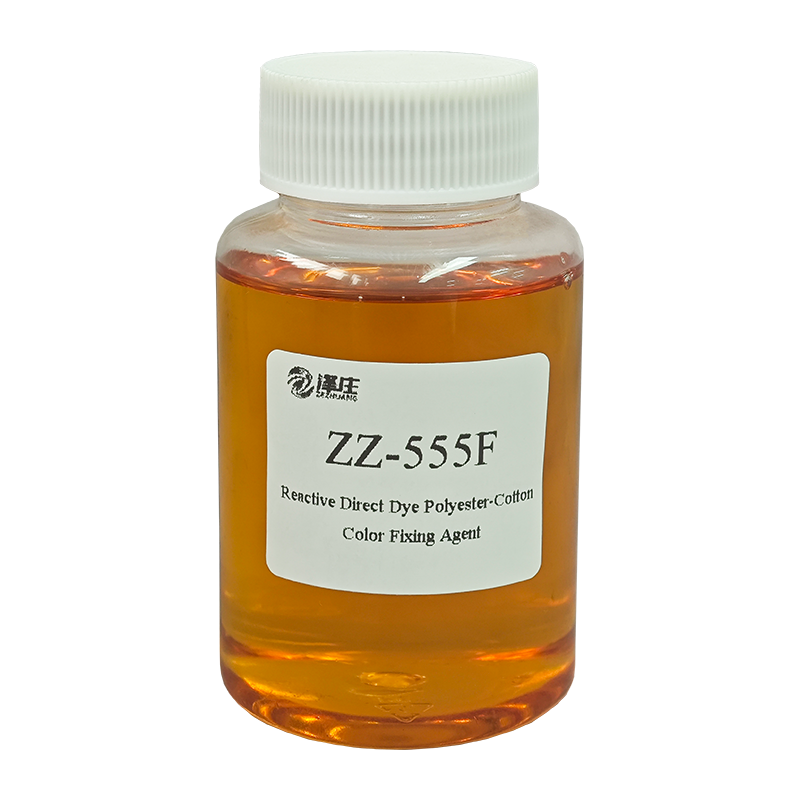
ZZ-555F Reactive Direct Dye Polyester-Cotton Color Fixing Agent


Product Introduction

This product is applied to the after-treatment of reactive dyes, direct dyes and polyester-cotton blended dyed fabrics. With reactive groups contained in its molecular structure, it can remarkably improve various fastness properties of fabrics.


Performance Characteristics

The fixing working solution features little color shedding, effectively preventing shade fading and color variation.

Fabrics treated with this product have minimal color change without affecting the original fabric style.

It can significantly enhance the soaping fastness, perspiration fastness and other fastness properties of treated fabrics.

It owns outstanding alkali resistance and is applicable to the mercerizing process after cotton color fixing.

Formaldehyde-free and compliant with environmental protection standards.

Resistant to chlorine bleaching.

Product Specifications

Chemical Composition: Cationic polymer

Appearance: Light yellow to yellow liquid

pH Value: 4.5-6.5

Ionicity: Cationic

Solubility: Easily soluble in water

Stability: Resistant to acid, alkali, electrolyte and hard water

Application Instructions

Before color fixing treatment, fully rinse the dyed fabrics (soaping is required if necessary) to remove residual dyes, salts and alkalis, so as to ensure optimal color fixing effect.

Recommended Dosage and Process:

A. Dipping Method

ZZ-555F: 1-5% o.w.f

Liquor Ratio: 1:15-20

Temperature & Time: 20-30℃ × 15-20min

Process: Dyed fabric → Dip in color fixing solution at 20-30℃ for 15-20 minutes → Water washing → Drying

B. Padding Method

ZZ-555F: 10-50 g/L

Process: Dyed fabric → Pad with color fixing solution at room temperature → Drying

Packaging & Storage

Packaging: 125kg per drum

Storage: Store indoors at 5-30℃. Keep away from direct sunlight, place in a dry and shady place, and avoid freezing.

Shelf Life: 6 months
Inquiry Now
About Us
Hubei Zezhuang Technology Industrial Development Co., Ltd.

Hubei Zezhuang Technology Industrial Development Co., Ltd., established in 2011 as Shanghai Zezhuang Industrial Co., Ltd., is located in Fengjing Town, Jinshan, known as the "crossroads of Wu and Yue" and often referred to as "three steps and two bridges". It is a high-tech enterprise specializing in the research, development, production, and sales of textile dyeing and finishing auxiliaries. The company's products cover the entire process of various technological chains, including textile printing and dyeing, coating, lamination, calendering, setting, washing, printing, and bronzing. The company boasts independent R&D, testing, and after-sales centers. It has established long-term cooperation mechanisms with Wuhan Textile University, Guangdong Wuyi University, Hunan University of Engineering, and other institutions.
The company employs two Ph.D. holders in chemistry, eight master's degree holders, and twenty-three bachelor's degree holders. Currently, the company has its marketing headquarters in Suzhou, Jiangsu (Suzhou Zezhuang New Material Co., Ltd.), a production base in Hangzhou, Zhejiang, and sales offices in Zhejiang, Hubei, Guangdong, Fujian, Shandong, and other places. Zhejiang Yongshuo Import and Export Co., Ltd., as the foreign trade company of Zezhuang Industry, focuses on expanding overseas markets. In 2023, the company established a new production base in Jingzhou, Hubei, and founded Hubei Zezhuang Technology Co., Ltd., covering an area of 60 acres with a total investment of 380 million yuan.
We will strengthen our industrial layout, increase R&D investment, and commit to the development and promotion of green and environmentally friendly products that are low-pollution, high-performance, multifunctional, and high-value-added. Guided by the concept of green and environmentally friendly development, we aim to achieve high-quality and sustainable development for our enterprise, and provide a safe, comfortable, and beautiful living environment for society.

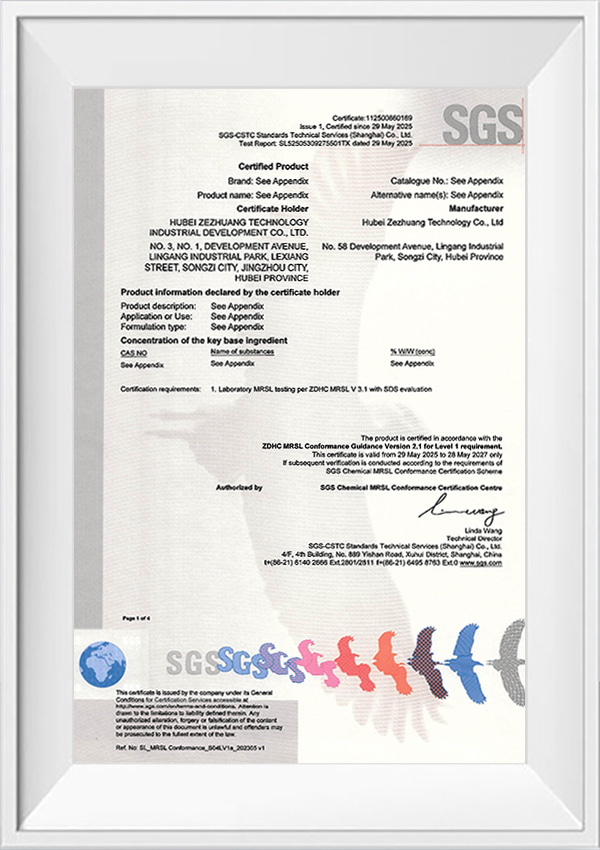
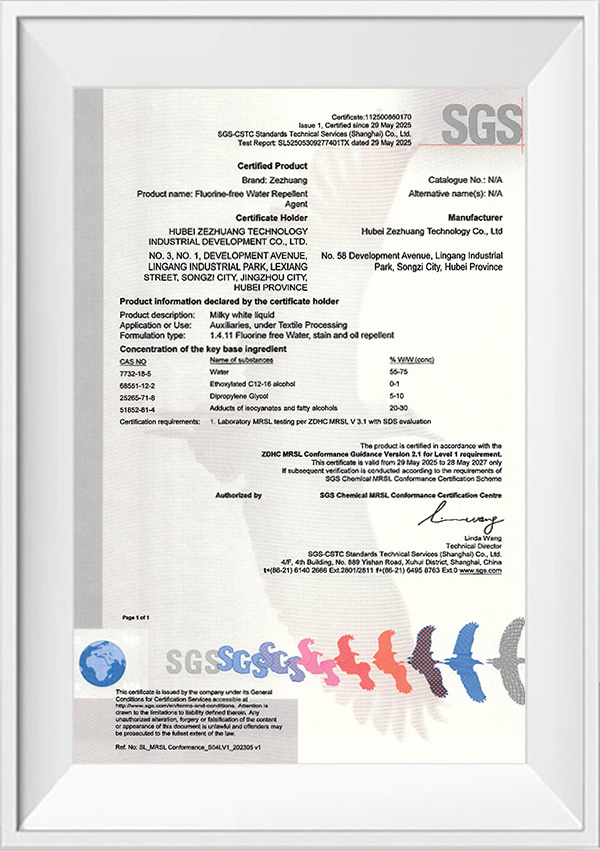
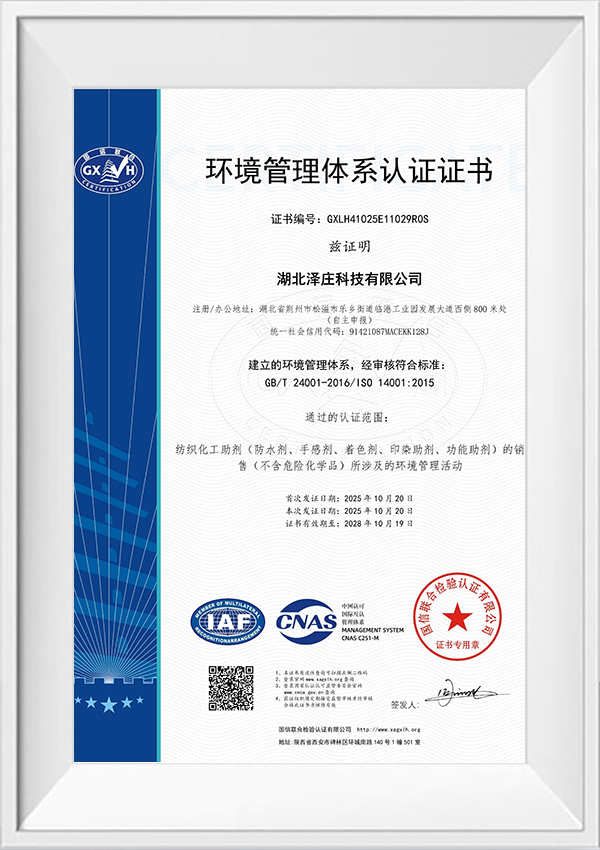
Certificate Of Honour
  • 112500860169
  • 112500860170
  • Environmental management system certification
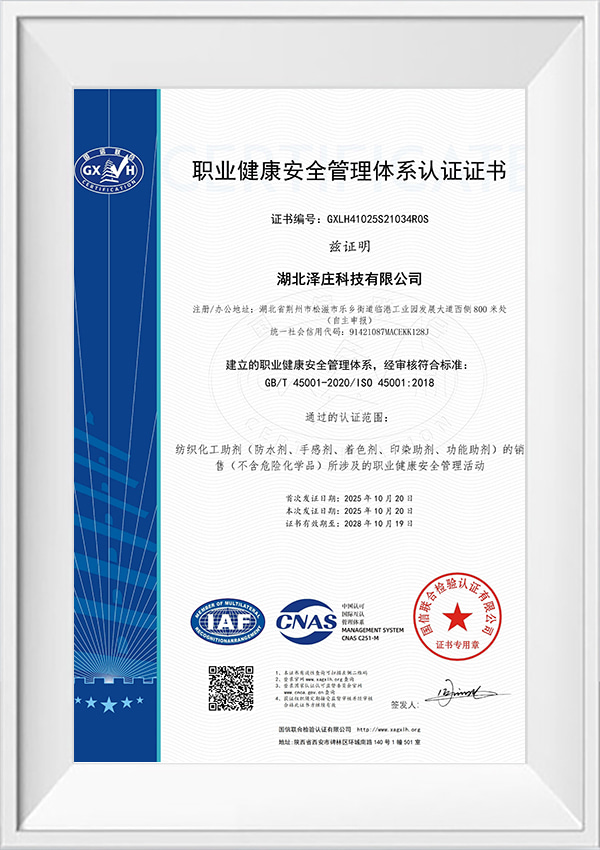
  •  Occupational Health and Safety Management System Certification Certificate
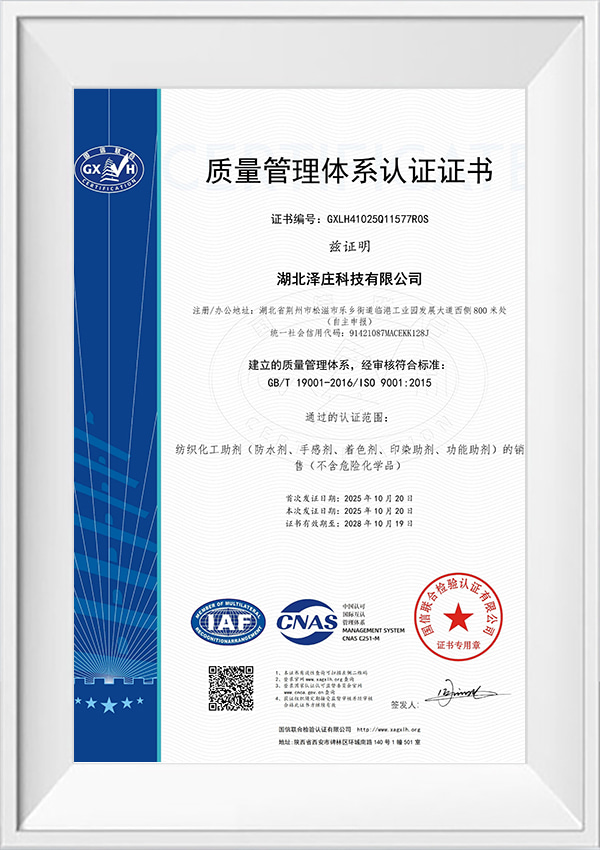
  • Quality management system certification
Latest Updates
  • Struggling with failed batches from the wrong water repellent? This costly mistake frustrates your team and customers. A systematic approach is the only way to choose the right agent.

    The key is a systematic approach. First, define your fabric and required performance. Then, evaluate the agent's durability, compatibility with your existing dyeing process and chemicals, and its compliance with safety and environmental regulations. Finally, you must test it in your own facility.


    I've seen so many factory managers treat this decision like they're buying vegetables at the market—they just look at the price tag. But Chen Ning, our founder, always taught me that choosing a water repellent is a core engineering decision. It affects everything that comes after it in the process. Getting it wrong leads to waste, while getting it right is a source of profit and reliability. Let’s break down the exact steps you need to take to avoid the common pitfalls and find a product that truly works for your dye factory.

    What Fabrics Are You Treating & What Level of Water Repellency Do You Need?

    Using one agent for all fabrics sounds simple, right? But this one-size-fits-all approach leads to poor results on some textiles and costly overkill on others.

    Start by identifying your fabric type—natural like cotton or synthetic like polyester. Then, define the performance level you need, whether it's basic shower-proofing or high-level waterproofing, which can be measured with standard tests like the spray test or hydrostatic pressure test.


    The first step is always to look at what's in front of you. A water repellent that works wonders on tightly woven polyester might completely fail on a loosely knit cotton. Based on my experience helping clients troubleshoot, this is the most common starting mistake. We need to be more specific.

    Key Fabric Characteristics

    The agent's ability to bond with the fiber is everything. Synthetic fibers like polyester are hydrophobic (they naturally repel water), so they are easier to treat. Natural fibers like cotton are hydrophilic (they absorb water), so they require a more robust film-forming agent. The fabric's construction also matters immensely. A dense, tightly woven fabric provides a better surface for the repellent to form a uniform layer, while an open, knit fabric is much more challenging.

    Defining Performance Levels

    You must be precise about what "water repellent" means for your customer. You can use industry-standard tests to set clear targets.

    Performance Level Typical Use Case Target Test Standard
    Basic (Showerproof) Casual wear, light jackets AATCC 22 Spray Test: 80-90
    Medium (Rain Resistant) Everyday outdoor wear, sportswear AATCC 22 Spray Test: 90-100
    High (Waterproof) Technical outdoor gear, tents AATCC 127 Hydrostatic Pressure: >5000mm

    Don't just ask for a "good" water repellent. Ask for an agent that achieves a spray test score of 90 on your specific polyester-cotton blend fabric. This clarity prevents misunderstandings and disappointment.

    How Durable and Effective is the Water Repellent Agent? (Beyond Initial Spray Rating!)

    Your fabric looks perfect right after treatment. But after a few washes, customers complain that the expensive water-repellent feature is gone. Durability is the real test of quality.

    True effectiveness is measured by performance after multiple wash cycles and abrasion tests. An agent that maintains a high spray rating after 20 or more launderings is far superior to one that only performs well initially. This is the difference between a real and a fake finish.


    I remember a client who was thrilled with a cheap agent. The initial spray test was a perfect 100. They were so happy with the cost savings. But after we simulated just three gentle home washes in our lab, the rating dropped to 70. They had to rework an entire batch, which cost them more than if they had bought the better agent in the first place. Initial results can be deceiving; longevity is where the real value lies.

    Measuring Wash Durability

    The supplier's technical data sheet (TDS) should state the performance after a certain number of washes (e.g., "maintains a 90 spray rating after 20 washes"). But you must verify this. Test it in your own lab according to standard washing procedures like AATCC 135. Does it hold up? How steep is the drop-off in performance? A gradual decline is normal, but a sudden cliff-edge drop after 5 washes is a major red flag.

    Considering Abrasion and Use

    Fabric doesn't just get washed; it gets worn. Think about a jacket rubbing against a backpack strap or trousers rubbing against a chair. This is called abrasion. A good water repellent finish should be resistant to this "crocking" or rubbing. There are specific tests for this, but a simple, practical test in your lab can tell you a lot. Rub a sample with a standard cloth and see if the water repellency is affected. A durable finish should resist both washing and daily wear and tear.

    Measuring Wash Durability

    The supplier's technical data sheet (TDS) should state the performance after a certain number of washes (e.g., "maintains a 90 spray rating after 20 washes"). But you must verify this. Test it in your own lab according to standard washing procedures like AATCC 135. Does it hold up? How steep is the drop-off in performance? A gradual decline is normal, but a sudden cliff-edge drop1 after 5 washes is a major red flag.

    Considering Abrasion and Use

    Fabric doesn't just get washed; it gets worn. Think about a jacket rubbing against a backpack strap or trousers rubbing against a chair. This is called abrasion. A good water repellent finish should be resistant to this "crocking" or rubbing. There are specific tests for this, but a simple, practical test in your lab can tell you a lot. Rub a sample with a standard cloth and see if the water repellency is affected. A durable finish should resist both washing and daily wear and tear.

    Is the Agent Compatible with Your Dyeing Process, Chemicals & Equipment?

    You found an amazing water repellent. But when you add it to your bath, it causes spots on the fabric or changes the color of your dye. Now you have a huge problem.

    Compatibility is critical, especially in a dye factory. Check the agent's ionicity—non-ionic is often the safest choice as it won't react with other cationic or anionic auxiliaries like softeners. Also, ensure it is stable at your process pH and temperature.


    Chen always says, "A dyehouse is a complex soup of chemicals." You are not just adding one product; you are creating a recipe. A new ingredient can spoil the whole dish if it doesn't get along with the others. In my work, I've seen more batches ruined by chemical incompatibility than by almost any other cause. This is especially true when adding finishes after dyeing.

    The Critical Role of Ionicity

    This is the most important technical point. Chemicals have an electrical charge.

    Cationic: Positive charge (+)

    Anionic: Negative charge (-)

    Non-ionic: Neutral charge

    If you mix a cationic product (like many softeners) with an anionic product, they will react, clump together, and precipitate out of the solution. This creates stains and residue on your fabric. Since you may use other auxiliaries for hand-feel or anti-static properties, a non-ionic water repellent is often the most versatile and safest choice for a dye factory. It's less likely to cause an unwanted reaction.

    Matching Process Parameters

    Your water repellent must work within your existing production setup. Don't change your entire process for one chemical.


    Factor Why It Matters What to Check on the TDS
    Ionicity1 Prevents reactions with other auxiliaries (softeners, fixing agents). Is it Cationic, Anionic, or Non-ionic?
    pH Stability The agent must perform in your dye bath's pH range without breaking down. Does it work in acidic, neutral, or alkaline conditions?
    Temperature It must be stable at your process temperatures and cure effectively. What is the recommended application and curing temperature?


    Before you even request a sample, check these three parameters on the product's technical data sheet. If it doesn't match your process, don't waste your time.

    Does it Meet Crucial Environmental, Safety & Target Market Regulations?

    You've produced a fantastic batch of performance fabric. But it gets rejected by your European buyer because it contains a banned chemical. This is a business-ending mistake.

    Before you even test an agent, verify that it complies with the regulations of your target market. Check for certifications like bluesign®, OEKO-TEX®, and ensure it meets the ZDHC MRSL. Specifically, confirm it is free from harmful long-chain fluorocarbons (PFOA/PFOS).


    Compliance is no longer optional; it is a requirement for market access, especially if you export to Europe or North America. I spend a lot of my time helping clients navigate these complex rules. It's not just about being "green"; it's about being able to sell your product. You must know the rules of the game before you start playing.

    The Shift Away from PFCs

    For years, C8 fluorocarbon chemistry provided the best water and oil repellency. However, these long-chain chemicals were found to contain PFOA and PFOS, which are persistent in the environment and harmful to health. As a result, they are now heavily regulated or banned worldwide. Most modern agents use shorter-chain C6 technology or are completely fluorine-free. You must confirm that your supplier's product is "PFOA/PFOS-Free1" or compliant with the latest EU REACH regulations.

    Key Certifications to Look For

    These logos are your passport to global markets.

    OEKO-TEX®2: This standard ensures the final product is safe for human contact and free from a long list of harmful substances.

    bluesign®: This is a more holistic system that certifies the entire production process, from chemical inputs to final fabric, ensuring it is sustainable and safe for workers, consumers, and the environment.

    ZDHC MRSL (Manufacturing Restricted Substances List): This is not a certification but a list of chemical substances that are banned from intentional use in the processing of textiles and apparel. Your chemical supplier must be able to confirm their products comply with this list.

    What's the TRUE Cost? Balancing Price, Concentration & Long-Term Performance?

    You see two agents. Agent A costs $2/kg and Agent B costs $4/kg. The choice seems obvious, right? But this simple view often leads to higher an overall cost.

    The true cost is not the price per kilogram. It's the cost per meter of treated fabric. A more expensive, highly concentrated agent may require a much lower dosage, making it cheaper in the long run. Also factor in re-processing costs from failed, cheaper agents.


    At ZeZhuang, we constantly have to explain this concept. A low price per kilo is a very effective sales trick, but it hides the real story. You must look at the "cost-in-use." This requires a bit of math, but it's a calculation that will save you a lot of money. The goal is to find the lowest cost for the required performance, not the lowest price on the invoice.

    Calculating the Cost-in-Use1

    Let's break it down with a simple example. You need to treat 1,000 meters of fabric.


    Parameter Agent A (Cheap) Agent B (Premium)
    Price per kg $2.00 $4.00
    Solid Content 15% 30%
    Required Dosage 60 g/L 30 g/L
    Total kg Needed 60 kg 30 kg
    Total Chemical Cost $120.00 $120.00


    In this scenario, the "expensive" agent has the same cost-in-use because it's twice as concentrated. Now, what if Agent B also provides better durability, reducing your re-processing rate2 from 5% to 1%? Suddenly, the premium agent becomes significantly cheaper when you account for the waste and extra labor of the "cheap" one. Don't be fooled by the price per kilo. Always ask for the recommended dosage and do the math.

    How Eco-Friendly is the Solution? Should Sustainability Be a Priority?

    You may think eco-friendly options are just for niche brands. But major brands and consumers are demanding more sustainable products. Ignoring this trend is a risk to your future business.

    Sustainability is increasingly a commercial requirement. You should evaluate fluorine-free options alongside C6 agents. While fluorine-free agents may have lower oil repellency, their water repellency and environmental profile are excellent and meet the demands of a growing market segment.


    The market is clearly shifting. While high-performance C6 technology is still necessary for certain technical applications, the demand for fluorine-free water repellents is growing rapidly, especially for casual wear and indoor textiles. We've invested heavily in developing these solutions because we see it as the future. Choosing a sustainable option is not just about environmental responsibility; it's about positioning your factory as a forward-thinking partner for modern brands.

    Fluorine-Free vs. C6: A Quick Comparison

    This is a key strategic decision you'll need to make with your clients.

    C6 Water Repellents:

    Pros: Excellent water repellency and good oil repellency. Very durable.

    Cons: Contains fluorine, facing increasing regulatory pressure.

    Best for: High-performance outerwear, workwear, and applications where oil/stain resistance is critical.

    Fluorine-Free Water Repellents:

    Pros: Excellent environmental profile (biodegradable, no fluorine). Meet all regulations. Great water repellency.

    Cons: Little to no oil repellency. Durability might be slightly lower than the best C6 options.

    Best for: General apparel, sportswear, and any product where sustainability is a key selling point. Offering both solutions allows you to cater to the full spectrum of market needs.

    Have You Rigorously Tested It in YOUR Lab and Production Environment?

    The supplier's data sheet looks perfect, and the sample performed well in a beaker. But theory is one thing, and your production line is another. Never skip the final, most crucial step.

    You must validate any new agent in your own facility. Start with a lab trial to confirm compatibility and performance. Then, run a small pilot production batch to see how it performs on your actual machinery before committing to bulk purchasing.


    This is the golden rule Chen built our company on: "Trust, but verify." I cannot stress this enough. I have seen perfect lab results fail in production because of variables like water hardness, machine speed, or drying temperature. A supplier's lab conditions are not your lab conditions. Your factory is the only test that matters.

    The Three-Step Testing Process

    Follow this sequence to avoid costly mistakes.

    Lab Dip Test: This is your first check. Mix the agent with your other standard chemicals (dye, fixing agents, softeners) in a beaker. Does the solution remain stable? Does it form clumps? Dip a piece of your actual fabric. After drying and curing, does it meet your performance target (e.g., spray test)? This simple test weeds out 80% of unsuitable products.

    Pilot Production Trial: If the lab test passes, run a small batch (e.g., 50-100 meters) on your production machinery. This is a real-world test. It checks how the agent behaves in your padding mangle and at your dryer temperatures. Are there any application issues like foaming or buildup on the rollers? Does the final product meet the spec?

    Bulk Production: Only after the pilot trial is successful should you consider using the agent for a large order. By following this process, you move from a theoretical choice to a proven solution with confidence.

    Conclusion

    Choosing the right water repellent is a system, not a single decision. By evaluating your fabric, performance, durability, compatibility, and true cost, you can make a smart, profitable choice.

    Understanding Cost-in-Use helps in making informed decisions about chemical purchases, ensuring you get the best value for your investment.

    Exploring the impact of re-processing rates can reveal hidden costs and savings, guiding you to choose the most efficient chemical agents.

    Hubei Zezhuang Technology Industrial Development Co., Ltd. Jul 30 , 2025
    Hubei Zezhuang Technology Industrial Development Co., Ltd. Company News
  • Frustrated by customer complaints about color issues? Bad color fastness can ruin your reputation. I'll show you how to pinpoint the exact cause and fix it for good.

    The solution to color fading and bleeding lies in correctly identifying the root cause. Lightfastness depends on dye structure, while rubbing fastness depends on removing unfixed dye. For synthetics, preventing dye migration during heat treatments is key. Each problem requires a specific, targeted solution.


    I've spent my entire career in textile chemistry, and if there's one thing I've learned, it's that "color fastness" isn't one single problem. It's a collection of different challenges, and each one has its own unique solution. A fix for sun fading won't help with color rubbing off, and neither will fix issues on polyester. The key is to stop guessing and start diagnosing. Once you know exactly what you're up against, the path to a high-quality, reliable product becomes much clearer. Let's break down the most common problems I see and the practical steps you can take to solve them.


    Why Do Light-Colored Fabrics Fade in the Sun?

    Your light-colored fabrics look perfect, but fade quickly once the customer takes them home. This is a classic lightfastness issue. I'll explain why it happens, especially with certain colors.

    Light fabrics often fade because common reactive dyes, especially reds and yellows, have a light-sensitive azo structure. On pale shades, single dye molecules are more exposed and easily broken down by UV light. The fix starts with choosing a more stable dye chemistry upfront.


    Over the years, I've seen countless cases of poor lightfastness, and it almost always comes down to the dye's core chemistry. Around 70% of reactive dyes are based on an "azo" structure. This structure is fantastic for creating vibrant reds and yellows, but it's also their biggest weakness—it's sensitive to UV light. When sunlight hits the fabric, it attacks these azo bonds and breaks them down, causing the color to fade.

    This problem is much worse on light or pastel shades. Why? Because the dye molecules are spread out on the fiber as single, isolated units. They have nowhere to hide. In dark shades, the dye molecules are packed tightly together, forming aggregates that offer some self-protection. Think of it like a lone soldier versus a packed phalanx. The lone soldier is an easy target. That's why your light yellow shirt fades faster than your navy blue one.

    Dye Concentration Secrets: Light vs. Dark Fading?

    You've noticed that light colors fade in the sun, while dark colors sometimes rub off on furniture. Are these related? No, they are completely different problems requiring different solutions.

    The secret is that light and dark shades fail for different reasons. Light shades fade from a chemical breakdown caused by UV light. Dark shades lose color because unfixed dye particles on the surface physically rub off. You can't solve one with the other's solution.


    In my experience, factory managers often get confused here and misdiagnose the problem. It’s crucial to understand the distinction, so let me make it simple. One is a chemical reaction, the other is a physical failure.

    Here is a simple way to think about it:

    Feature Light Shade Fading Dark Shade "Fading" (Rubbing)
    Problem Poor Lightfastness Poor Rubbing Fastness (Crocking)
    Root Cause UV light chemically destroys the dye molecule. Unfixed dye particles sit on the fiber surface and are rubbed off.
    Appearance Color gradually becomes paler, washed out. Color transfers onto other surfaces when rubbed, wet or dry.
    Key Fix Choose dyes with a UV-stable chemical structure. Improve the washing process to completely remove all loose dye.


    As you can see, trying to fix a rubbing issue by changing to a light-stable dye won't work. And improving your washing process won't stop a light-sensitive dye from fading in the sun. You must first correctly identify if your problem is chemical (light) or physical (rubbing).

    How to Stop Sun Damage with 3 Dye Selection Tactics?

    Tired of fabrics failing sun-fastness tests? Choosing the right dye can feel like a gamble. I use three reliable tactics to guarantee results every time, and you can too.

    To stop sun damage, first, select dyes with stable structures like anthraquinone or phthalocyanine. Second, ensure all dyes in a combination have similar lightfastness. Third, stop using ineffective UV absorbers, which can actually harm the fiber.


    After diagnosing poor lightfastness, here are the exact steps I take. These aren't theories; they are practical rules for the dyehouse.

    Tactic 1: Choose a Stable Dye Structure.

    Instead of the light-sensitive azo dyes for your critical shades, switch to dyes with a more robust parent structure. I always recommend anthraquinone1 or phthalocyanine2 based dyes. These are typically in the blue and green range and are naturally much more resistant to UV degradation. For a pale blue, using a phthalocyanine dye is one of the safest bets you can make for excellent lightfastness.

    Tactic 2: Balance Your Color Combinations.

    When you make a combination shade, like a beige or a grey, your final fastness is only as good as your weakest dye. I’ve seen people mix a highly stable blue with a very poor red. The result? The fabric color shifts to a bluish-grey in the sun as the red component fades away. You must ensure all dyes in your recipe have a similar, high lightfastness rating1.

    Tactic 3: Avoid Ineffective Shortcuts.

    Some people try to "boost" fastness by adding UV absorbers1 in the finishing stage. In my experience, this is a waste of money and can even be damaging. These additives have very little effect on reactive dyes2 and can weaken the cotton fiber itself over time. The real solution is choosing the right dye from the start, not trying to apply a bandage at the end.

    Why is Dark Fabric Rubbing Off and Staining?

    Customers complaining that their new dark garments are staining their hands or furniture? This is a classic wet and dry rubbing fastness failure. It's almost always caused by unfixed dye.

    Dark fabric rubbing is caused by loose, unfixed dye that wasn't properly washed off. This problem is made worse by using vinyl sulfone dyes and hard water, which creates a sticky dye precipitate that's very difficult to remove completely.


    When we dye a dark shade like navy or black, we use a lot of dye. Not all of it chemically bonds to the fiber. The dye that is left over is called "floating color." The goal of the washing or "soaping" process is to remove all of this floating color. If we fail, it stays on the surface and easily rubs off.

    I see this problem most with vinyl sulfone (VS) reactive dyes. They are popular, but their hydrolyzed form is very substantive to cotton, meaning it sticks to the surface like a magnet and is hard to wash away. The problem becomes a disaster if you use hard water. The calcium and magnesium ions (Ca²⁺/Mg²⁺) in hard water react with the loose dye and soaping agents to form a sticky, insoluble precipitate. This gunk traps the floating color on the fabric surface. You can wash it for hours, but that sticky mess won't budge. The only real solution is to prevent it from forming in the first place.

    How Can I Boost Wet Fastness with a Pretreatment Guide?

    Is your wet fastness inconsistent from one batch to the next? You focus on the final wash, but the problem often starts much earlier. I'll share my complete process checklist.

    To truly boost wet fastness, you must control the entire process. It starts with excellent pretreatment for absorbency and ends with low-temperature finishing. A holistic approach is the only way to guarantee consistent, high-quality results every single time.


    Excellent wet fastness is not the result of one magic step. It is the result of getting every step right. Over the years, I've developed a checklist of 7 key benchmarks. If you can meet these on every batch, your rubbing fastness issues will disappear.

    Thorough Singeing: Start with a clean slate. A smooth fiber surface with no fuzz means less area for loose dye to get trapped.

    Excellent Absorbency: Your scouring and bleaching must be perfect. The fabric needs to act like a sponge. I test this with a capillarity test—it must absorb water upwards more than 8cm in 30 minutes.

    Deep Dye Penetration: Choose the right dyeing method. For deep, even dyeing, jigger or cold pad batch methods are far superior to continuous pad dyeing, which can leave more dye on the surface.

    Control Dye Load: Do not oversaturate the fiber. I always advise dyeing at a depth that is no more than 90% of the fiber's maximum saturation value. Any more dye is just creating more floating color to wash off later.

    Effective Soaping: Use a dynamic, high-flow washing process with a gradient of temperatures. This helps pull the loose dye out and away from the fabric efficiently.

    Use Soft Water: This is non-negotiable. Using hard water is like trying to wash greasy hands with cold water. You must use soft water, especially in the soaping baths, to prevent dye precipitates.

    Low-Temperature Finishing: High heat during drying or stentering can cause any remaining dye inside the fiber to migrate to the surface. Keep your finishing temperatures as low as possible.

    My Fabric Fails Chlorine or Sweat Tests? What Are the New Fixes?

    Your fabric passes all standard tests, but fails when exposed to real-world conditions like a swimming pool or human sweat. These special fastness demands require specialized chemistry.

    Failures against chlorine or sweat are rooted in the dye's molecular structure. You must select dyes specifically designed to resist these attacks. For chlorine, the dye needs a protective shield. For sweat, it needs to resist a specific chemical reaction.


    This is where my work as a chemist gets really interesting. Standard fastness is one thing, but performance fabrics need another level of engineering at the molecular scale.

    Chlorine Fastness

    When a dye fails in chlorinated water, it's because the chlorine molecule is attacking and destroying it. The solution is to use dyes that have a built-in defense. Top-performing dyes achieve this through steric hindrance. They are designed with bulky molecular groups (like an ortho-sulfonic acid group) positioned right next to the vulnerable part of the dye. This group acts as a physical shield, blocking the chlorine from ever reaching its target.

    Sweat-Light Fastness

    This is a complex failure seen in sportswear. It's a combined attack. Amino acids in sweat leach out the metal complex (often copper) from the dye molecule. This free copper then acts as a catalyst, dramatically accelerating fading when exposed to sunlight. The solution is to use dyes with a more stable molecular structure that "locks" the metal in place, preventing the amino acids from pulling it out.

    Side Effects from Finishing

    Finally, be careful with your softeners! Cationic softeners are very popular, but they carry a positive charge. Dyes have a negative charge. The softener can act like a magnet, pulling negatively charged dye molecules right off the fiber, which ruins your wet fastness. For high-fastness goods, always choose a non-ionic or a specialized hydrophilic softener.

    Why Is My Disperse Dye Bleeding During Ironing?

    Your polyester fabric looks great after dyeing, but the customer complains that the color stains other clothes during ironing or storage. This is thermomigration, and it is entirely preventable.

    Disperse dye bleeding, known as thermomigration, happens when heat and certain auxiliaries cause dye to move from inside the fiber to the surface. Controlling your dyeing depth, setting temperature, and performing a proper reduction clear will stop it.


    Thermomigration is a huge headache for anyone working with polyester. The mechanism is simple: during heat setting or finishing (usually above 150°C), finishing agents on the fabric surface (especially non-ionic ones) can act like a solvent. They dissolve the disperse dye that is already inside the polyester fiber, pulling it out to the surface. Once it's on the surface, it has terribly poor rubbing fastness.

    After years of troubleshooting this exact problem, I developed what I call the "Iron Rules" for preventing thermomigration. Follow these three rules strictly, and you will solve the issue.

    Dye Below Saturation: Never dye to the absolute maximum depth. Always aim for a dyeing depth that is less than or equal to 90% of the fiber's saturation value. This ensures all the dye is securely locked inside the fiber, with no excess crowding near the surface.

    Aggressive Reduction Clearing: After dyeing, you must perform a thorough reduction clear. This chemical wash destroys and removes any and all loose dye particles from the fiber surface. Afterward, neutralize the fabric to a pH between 5.5 and 6.0 to ensure stability.

    Strict Temperature Control: Heat is the trigger. You must control your heat-setting temperature. I've measured it: for every 10°C you increase the temperature above 150°C, you can expect your fastness grade to drop by half a point. Keep setting temperatures at 150°C or below whenever possible.

    Conclusion

    Solving color fastness isn't about one magic bullet. It’s about being a detective, finding the specific cause, and applying precise control over your chemistry and processes from start to finish.

    Understanding UV absorbers can help you make informed decisions about dyeing and finishing processes. 

    Learning about reactive dyes will enhance your knowledge of effective dyeing techniques and their benefits. 

    Hubei Zezhuang Technology Industrial Development Co., Ltd. Jul 19 , 2025
    Hubei Zezhuang Technology Industrial Development Co., Ltd. Company News
  • Struggling to tell apart water-repellent, resistant, and waterproof claims? This confusion can lead to costly mistakes and products that fail. I'll explain the real technical differences.

    "Water-repellent" is a surface finish that makes water bead up. "Water-resistant" handles light water pressure but has limits. "Waterproof" provides a complete barrier to water, is proven by lab tests, and has sealed seams to stop leaks.


    These terms may seem similar, but in the textile industry, they describe very different levels of performance. In my years developing chemical solutions, I've seen how choosing the wrong one can disappoint customers and hurt a brand's reputation. To avoid these issues, you need to look past the marketing words and focus on the technical data. Let’s break down exactly what each term means, so you can make informed decisions for your products.

    Introduction: Why Do These Water Terms Cause So Much Confusion?

    Do marketing terms like "weather-resistant" create problems for your technical team? This vague language causes confusion and leads to products that don't meet customer expectations. Let’s clarify why.

    The confusion exists because marketing often uses these terms without supporting data. "Water-repellent" is a surface treatment, "water-resistant" implies protection against pressure, and true "waterproof" performance is verified by specific lab tests. Without this data, the terms are often meaningless.


    The main source of this confusion is the gap between marketing language and technical reality. I've consulted for many companies, and I see this problem constantly. A luxury handbag brand might label its product "waterproof," but this usually just means it can survive a rain shower or a spilled drink. It has likely never undergone a formal water pressure test. In contrast, technical outdoor gear claiming to be "waterproof" must pass strict laboratory standards, such as ISO 811. The term "weather-resistant" is even more confusing because it has no official technical definition. It sounds professional, but what does it actually promise? As a technical manager, you must always ask for the test data. The numbers from tests like AATCC or ISO tell the true story, not the slogans on the hang-tag.

    What Exactly is Water-Repellent (DWR) and How Does it Work?

    Have you ever noticed a new jacket stops beading water after a few wears? This quick failure of the finish can be very frustrating for customers. Let's look at why this happens.

    A water-repellent finish uses a chemical treatment called DWR (Durable Water Repellent). It lowers the fabric's surface energy, causing water to form beads and roll off. This is not waterproofing; it's a temporary surface treatment that degrades with use, dirt, and washing.


    A water-repellent finish functions through what we call the "lotus effect." The DWR chemical creates a microscopic, spiky texture on the fabric's surface. This texture minimizes the contact area for water, causing droplets to form tight beads and roll away instead of soaking in. The standard lab test for this is the AATCC 22 Spray Test, which gives a score from 0 to 100 based on how well the fabric repels a spray of water. A new garment might score a 90 or 100, which looks great. However, this finish is fragile. Dirt and oil can clog the microscopic texture, and abrasion from use or washing can wear it down. In my experience, probably 90% of customer complaints about a "leaky" waterproof jacket are actually due to the DWR finish failing. The fabric itself may still be waterproof, but once the surface fabric gets soaked, it feels cold, clammy, and seems like it's leaking.

    How Effective is “Water-Resistant,” and What Are Its Limits?

    Have you ever trusted a "water-resistant" label, only to find yourself soaked in a real downpour? This inconsistent performance can damage a product's reputation. Let's define what true resistance means.

    A "water-resistant" fabric is built to resist water penetration under pressure. Its real performance is measured with a hydrostatic head test, like AATCC 127, and is rated in millimeters (mm). Without this number, the "water-resistant" claim is an unreliable marketing promise.


    The term "water-resistant" becomes meaningful only when it's backed by a number. This number comes from a hydrostatic head test. In this test, we clamp a piece of fabric and apply an increasing column of water over it. We measure how high the column of water can get, in millimeters, before water is forced through the fabric. A higher number means better water resistance. For example, a basic umbrella might be called "water-resistant," but it may only have a 400mm rating, which is fine for a light drizzle. A good hiking jacket should have a rating of at least 5,000mm to handle sustained rain. When a supplier tells me their fabric is water-resistant, my first question is always, "What is the hydrostatic head rating in millimeters?" This separates a real technical fabric from a simple sales claim. It is important to remember that water resistance is different from water repellency. Repellency is a surface treatment (DWR), while resistance is about the fabric's actual structure preventing water from being pushed through.

    What Standards Define True “Water-Proof” Performance?

    Are you trying to develop a product that can survive a storm, not just a quick shower? Claiming a product is "waterproof" without meeting the correct standards is a major risk.

    True "waterproof" performance is not just about the fabric. It requires passing strict international standards like ISO 811, often with a rating above 8,000mm. Most importantly, all seams must be sealed with tape. Otherwise, water will leak through the stitch holes.


    "Waterproof" is not a marketing term; it is a technical benchmark proven in a lab. For textiles, a key standard is ISO 811, which is the hydrostatic head test I mentioned earlier. While a "water-resistant" rating might be 5,000mm, a fabric usually needs to hit 8,000mm, 10,000mm, or even higher to be considered truly "waterproof" for serious applications. However, the best waterproof fabric in the world is useless if the product construction is wrong. The weakest point is always the seams. I could give a client a fabric that resists 20,000mm of water, but if they stitch it into a garment without sealing those stitch holes, the final product is not waterproof. It is a sieve. True waterproof construction requires "seam taping." This process involves applying a special waterproof tape over every single seam with heat and pressure, creating a complete barrier that is just as strong as the fabric itself. This step is not optional for any product that needs to be genuinely waterproof.

    Choosing Wisely: Which Protection Level Matches Your Needs? (Repellent, Resistant, or Proof?)

    Now you know the definitions, but how do you choose the right one? Using too much protection is expensive and unnecessary, while using too little leads to product failure.

    Match the level of protection to the product's final use. For light drizzle or accidental spills, a "water-repellent" DWR finish is enough. For hiking in the rain, you need a "water-resistant" fabric with a 5,000mm+ rating. For extreme weather, demand certified "waterproof" gear with taped seams.


    The right choice always depends on the real-world situation the product will face. You have to balance performance with cost and comfort. For example, a water-repellent DWR finish is perfect for a casual city jacket. It provides enough protection against a spilled coffee or a quick run through a light shower without the added cost or reduced breathability of a fully waterproof membrane. However, for a hiking jacket, you need more. You need a water-resistant fabric with a verified hydrostatic head rating to handle sustained rain and wind pressure. Finally, for extreme activities like mountaineering or sailing, failure is not an option. Here, you must use certified waterproof fabric and ensure the garment has taped seams. It’s a matter of safety and performance.


    Need/Scenario Recommended Protection Level Key Test Standard
    Coffee Spill / City Use Water-Repellent (DWR) AATCC TM 22 Spray Test
    Hiking in a Light Rain 5,000mm+ Water-Resistant AATCC TM 127 Hydrostatic Pressure Test
    Storms / Heavy Rain Waterproof + Taped Seams ISO 811 / ASTM D3393


    Conclusion

    Understanding repellent, resistant, and waterproof is not about words. It's about using the right data and standards to deliver the exact performance your customers need.

    Hubei Zezhuang Technology Industrial Development Co., Ltd. Jul 18 , 2025
    Hubei Zezhuang Technology Industrial Development Co., Ltd. Company News
  • Struggling with water repellency failing after calendering? This costly reprocessing damages your timeline and profits. You need a reliable solution that maintains quality through every finishing step.

    The key to preventing water repellency loss is using a specialized water repellent engineered to withstand high temperatures. This, combined with optimizing your process parameters like liquid pick-up and temperature control, ensures the protective chemical finish remains effective after the heat and pressure of calendering.


    It is one of the most common frustrations I hear about in a textile finishing plant. You work hard to achieve a perfect water repellency score on a fabric batch. It passes all the initial tests with flying colors. Then, it goes through the calendering machine to get that smooth, glossy finish, and the results are a disaster. The water repellency has dropped, the batch fails inspection, and you are back at square one. This demoralizing cycle is not just an annoyance; it is a major drain on resources. We need to dig into why this happens so we can finally stop it.

    Why Do You Keep Reprocessing Fabrics After Calendering?

    Are you tired of seeing finished fabrics land back in the reprocessing pile? This expensive loop is a major production headache. It is time to understand the cause.

    Fabrics require reprocessing because standard water repellents break down under the intense heat and pressure of calendering. This degradation causes the waterproof grade to fall below the customer's specification, forcing a complete and costly do-over of the finishing process.


    Breaking the Expensive Cycle

    Reprocessing is more than just an inconvenience; it represents a significant financial loss. Every time a batch of fabric fails post-calendering, you are not just losing the cost of the initial chemicals. You are paying for everything all over again. This includes the labor to handle the fabric, the water and energy for washing and drying, and the new chemicals for the re-application. It also creates a bottleneck in your production schedule, potentially causing delays in shipments and hurting your relationship with clients.

    I remember Chen Ning, our founder, telling me about a visit to a factory where this exact problem brought production to a halt. A massive order of nylon taffeta for cycling wear was failing quality control after calendering. The technical manager, much like you, was at his wit's end. The deadline was approaching, and the constant reprocessing was putting the entire order at risk. After a close look, we realized their methods were sound. The problem was not in their process but in the water repellent they were using. It simply was not designed to survive their calendering conditions.

    Here is a look at what that costly cycle looks like compared to an efficient one.

    The Reprocessing Cycle The Efficient Cycle
    1. Apply Water Repellent 1. Apply Specialized Water Repellent
    2. Dry & Cure Fabric 2. Dry & Cure Fabric
    3. Test: Pass 3. Test: Pass
    4. Calender Fabric 4. Calender Fabric
    5. Test: Fail 5. Test: Pass
    6. Strip, Wash, & Redo 6. Ship to Customer

    Why Does Waterproof Grade Drop from 5 to 2 After Calendering?

    You achieve a perfect grade 5 water repellency. Then, after a run through the calender, it crashes to a grade 2. This huge drop feels unpredictable and hard to manage.

    The waterproof grade drops because calendering's high heat and intense pressure disrupt the water repellent's molecular structure. The heat flattens the protective hydrophobic groups, preventing them from standing up to repel water. The fabric's protective shield is effectively disabled.


    The Science Behind the Performance Drop

    To understand this, let's use a simple analogy. Think of the water repellent molecules on your fabric's surface as millions of tiny umbrellas. When applied and cured correctly, all these umbrellas are open and pointing upwards. They form a dense barrier that causes water droplets to bead up and roll right off. This is what gives you that perfect grade 4 or 5 performance.

    Calendering introduces two destructive forces: high temperature and high pressure. The heat makes the chemical structure of a standard water repellent unstable. The pressure from the rollers then physically forces these "umbrellas" to fold and lie flat against the yarn. The repellent is still on the fabric, but its functional structure is gone. It can no longer create the surface tension needed to repel water. This is especially true for fabrics like nylon taffeta, which often require high calendering temperatures to achieve the desired sheen, making them very susceptible to this problem. Sometimes, the effect is so bad that the grade drops to 0, leaving no water repellency at all.

    Several factors influence how severe this drop in performance will be.

    Influencing Factor Impact on Water Repellency
    Calendering Temperature1 Higher temperatures cause more damage to standard repellents.
    Fabric Type Synthetic fibers like nylon are often calendered at higher heat.
    Water Repellent Type2 Standard C6 or C8 repellents are more vulnerable than specialized ones.
    Fabric Cleanliness Any residues on the fabric can interfere with the repellent's bond.

    How Specialized Water Repellents Survive Calendering?

    What if your water repellent could easily handle the heat of calendering? Imagine keeping a high waterproof grade without any reprocessing. This is achievable with the right chemical technology.

    Specialized water repellents survive calendering because they are built with heat-resistant polymers and strong binders. These ingredients work together to form a tough, cross-linked film that locks the hydrophobic groups in place, keeping them functional even under extreme heat and pressure.


    The Makings of a High-Performance Repellent

    The difference between a standard water repellent and one that can withstand calendering lies in its core formulation. It is not just about the fluorine-based polymer that provides the repellency; it is about the entire support system built around it. A high-performance, calender-resistant repellent includes special additives that act like a scaffold. These are robust binders and cross-linking agents that create a durable, flexible, and heat-stable network on the fabric's surface.

    This network holds the water-repelling "umbrella" structures firmly in their upright, functional position. When the fabric goes through the hot calendering rollers, this strong chemical structure resists being flattened. It protects the orientation of the hydrophobic groups, preserving the fabric's water-shedding ability.

    This was the exact problem our founder, Chen Ning, tasked our R&D team with solving. We collaborated with a client who was consistently seeing their repellency on nylon taffeta fall from grade 5 to grade 2 after calendering. We studied their entire process—from their water source and liquid pick-up rate to the exact temperature of their rollers. Using this data, we provided a specialized water repellent from our portfolio. The result was transformative. After calendering, their waterproof grade was now a solid 4 to 4.5, only a minor drop of 0.5. This eliminated reprocessing entirely and stabilized their product quality.

    Feature Comparison Standard Water Repellent Calender-Resistant Repellent
    Polymer Structure Vulnerable to heat. Thermally stable.
    Binder System Weaker, softens under heat. Strong, heat-resistant binders.
    Cross-Linking Minimal. Extensive cross-linking creates a durable film.
    Post-Calendering Grade Drops significantly (e.g., to Grade 2). Maintains a high grade (e.g., Grade 4-4.5).


    Conclusion

    Stopping water repellency loss from calendering is possible. It requires a heat-resistant water repellent and a full understanding of your process to get consistent, reliable, and outstanding results.

    Understanding the effects of calendering temperature can help you optimize fabric performance and maintain water repellency. 

    Exploring different water repellent types can guide you in selecting the best option for your specific fabric needs. 

    Hubei Zezhuang Technology Industrial Development Co., Ltd. Jul 07 , 2025
    Hubei Zezhuang Technology Industrial Development Co., Ltd. Company News
  • Are your fabrics wearing out too fast? This problem can damage your brand's reputation and lead to costly customer returns. The solution is using the right textile auxiliaries.

    Textile auxiliaries are essential for improving fabric durability. In dyeing, fixing agents create strong chemical bonds to lock in color and prevent fading. In finishing, softeners reduce friction between fibers, while cross-linking agents strengthen the fabric’s structure, making it more resilient to wear and washing.


    Understanding how these chemicals work is key to producing high-quality, long-lasting textiles. But many people are not sure what these different chemicals are or what they do. Let's break it down piece by piece. I want to share what I've learned over my years in this industry to help you make better, more durable products. It all starts with knowing the tools you have available.

    What are the auxiliaries in textile dyeing?

    Does your fabric color fade or bleed after just a few washes? This makes your products look cheap and leads to unhappy customers. Using proper dyeing auxiliaries can fix this.

    Dyeing auxiliaries are chemicals used during the dyeing process. They include leveling agents for even color, dispersing agents to keep dyes stable, and fixing agents to bond the color to the fiber. They are the first step in creating a durable, colorfast fabric.


    When I first started, many clients like David, a textile engineer, faced issues with inconsistent color. The key to solving this was to look at the entire dyeing system, not just the dye itself. The auxiliaries are the support crew that ensures the main star—the dye—performs perfectly.

    The Role of Different Dyeing Auxiliaries

    Leveling Agents: These chemicals help the dye spread evenly across the fabric surface. Without them, you get blotchy, uneven color, which is an immediate quality failure. They manage how quickly the dye attaches to the fiber, ensuring a smooth, uniform result.

    Dispersing Agents: Particularly important for polyester dyeing, these agents keep tiny dye particles from clumping together in the water. If they clump, they can't penetrate the fibers properly, leading to poor colorfastness and surface crocking.

    Fixing Agents: This is where durability really begins. After the dye is on the fiber, a fixing agent creates a strong, almost unbreakable bond between the dye molecule and the fiber. This bond is what gives the fabric high wash fastness, preventing the color from bleeding and fading over time.

    What are the auxiliaries of textile processing?

    Is your fabric stiff or weak after dyeing? This can ruin the final product's feel and function, making it prone to tearing or pilling. Finishing auxiliaries are the answer.

    Textile processing, or finishing, auxiliaries are chemicals applied after dyeing to improve a fabric's final properties. They include softeners for a better hand feel, cross-linking agents for strength, and water repellents for function. These directly boost the fabric's long-term durability.


    In my experience, the finishing stage is where you transform a simple piece of cloth into a high-performance material. A customer might not see the leveling agent, but they will definitely feel the effect of a good softener or see the resilience from a cross-linking agent.

    Key Finishing Auxiliaries for Durability

    Softeners: These are crucial. They work by lubricating the individual fibers, which reduces the friction between them. When fibers rub against each other during wear or washing, it causes pilling and abrasion. A good softener acts like a protective shield, minimizing this damage and extending the fabric's life.

    Cross-linking Agents: These are often called resin finishers. They work on a molecular level to form new connections, or "cross-links," between the cellulose or protein chains within the fibers. This reinforces the fabric's internal structure, making it stronger, more resistant to wrinkling, and better able to hold its shape after many washes. It fortifies the fabric from the inside out.

    What affects the durability of a textile?

    Do you think durability is just about using a strong fiber? Many people make this mistake and are then surprised when their high-quality fabrics fail. The truth is, many factors are at play.

    Textile durability is influenced by the fiber type, the yarn structure, the fabric construction, and the chemical treatments it undergoes. The right auxiliaries protect and enhance the fabric's natural strength, while the wrong chemical process can severely weaken it.


    I often consult with clients like David who are trying to balance performance with sustainability. He knows that you can't just pick a strong fiber and hope for the best. The entire production chain has an impact on the final product's lifespan. A poor choice in one area can undo the benefits of another. It's a system where every part matters.

    A Breakdown of Durability Factors

    Factor How it Affects Durability Role of Auxiliaries
    Fiber Type The inherent strength of the fiber is the foundation. For example, nylon is naturally more abrasion-resistant than cotton. Auxiliaries can't change the fiber, but they can protect it. For example, a softener can reduce wear on weaker fibers like cotton.
    Yarn & Fabric Structure Tightly twisted yarns and densely woven or knit fabrics are physically stronger and more resistant to snagging and tearing. Cross-linking agents can help "lock" the yarns in place, preventing them from shifting and reducing seam slippage in looser weaves.
    Chemical Processing The dyeing and finishing process can either strengthen or weaken the fabric. Harsh chemicals or high temperatures can damage fibers. This is where auxiliaries are most critical. Good fixing agents, softeners, and cross-linking agents add layers of protection and reinforcement.

    What should be done to make the fabric durable?

    Do you want to create fabrics that last? Simply choosing one good component is not enough. You need a complete strategy that considers every step of the process to achieve true durability.

    To make fabric durable, you must combine strong fibers with a tight fabric construction and apply the right auxiliaries. Using high-performance fixing agents in dyeing, and a combination of softeners and cross-linking agents in finishing, is essential for long-term resilience.


    When I started my own company, my goal was to help clients build products they could be proud of. Durability is a huge part of that. It's not about one magic chemical. It's about a thoughtful, systematic approach. Here are the steps I guide my clients through.

    A Practical Guide to Durable Fabric

    Build a Strong Foundation: Start with the right fiber and a suitable fabric construction for the intended end-use. You can't make a weak fabric strong, but you can make a strong fabric even stronger.

    Protect During Dyeing: The dyeing process involves heat and chemicals that can stress the fabric. Use high-quality leveling and dispersing agents to ensure a smooth process. Most importantly, use a powerful fixing agent. Locking the color in securely prevents degradation from UV light and laundering, which is a key part of durability.

    Reinforce in Finishing: This is the final and most critical step. Apply a high-quality softener to reduce surface abrasion and pilling. Then, use a cross-linking agent to strengthen the fabric's core structure. This combination creates a two-level defense system: the softener protects the surface, and the cross-linking agent protects the interior. This synergy is what creates truly resilient, long-lasting textiles.

    Conclusion

    In short, textile auxiliaries are not just optional additives. They are fundamental tools that build durability into fabrics, from securing color to reinforcing fibers for a much longer life.

    Hubei Zezhuang Technology Industrial Development Co., Ltd. Jun 28 , 2025
    Hubei Zezhuang Technology Industrial Development Co., Ltd. Company News