

 English
 Español
Content
- 1 Why 20-Denier Nylon Is the Hardest Fabric to Protect
- 2 Five Requirements an Ultra-Thin Nylon Fabric UV Absorber Must Meet
- 3 Fiber-Bonded Absorber vs Surface Coating
- 4 How to Shortlist a UV Absorber for 20-40 g/m² Nylon Taffeta
- 5 Pad-Dry-Heat-Set Sequence
- 6 Validation Tests That Predict Field Performance
- 7 FAQ: Ultra-Thin Nylon Fabric UV Absorbers in Production
- 8 Protect Your Lightweight Fabrics Without Adding Weight
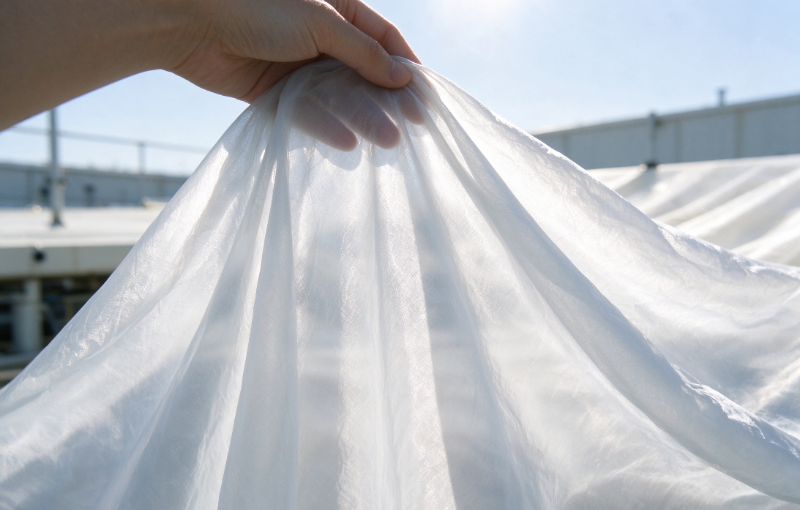
A 20-denier nylon taffeta at 32 g/m² can transmit more than 10 percent of UV-B radiation. That places a plain untreated shell at UPF 8 to 12, far below the UPF 40+ minimum that most outdoor brands quote. The usual fix, adding a nylon mesh liner to block light, adds cost, weight, and restricted breathability.
The faster fix is a chemistry-based one: an ultra-thin nylon fabric UV absorber formulated to exhaust onto low-denier filaments and block UV without adding measurable weight. The difference between a generic nylon UV absorber and one engineered for ultra-thin fabric is not marketing language. It shows up in exhaustion rate, durability after laundering, and absence of oligomer deposits on fine filaments.
When a garment team specifies UPF 50+ for a 30 g/m² shell, they are really asking for controlled chemistry, not another layer of fabric.
Why 20-Denier Nylon Is the Hardest Fabric to Protect
Ultra-thin nylon needs a chemistry-driven UV barrier because the yarn cannot physically block enough ultraviolet radiation. Nylon 6 and nylon 66 both absorb strongly in the 290-360 nm range, which accelerates photo-oxidation and breaks amide bonds; technicians see this as yellowing, tensile loss, and fraying at folds.
A 20 denier yarn with fine denier per filament (typically 20D/24f) also creates an open structure when woven; the cover factor of a standard 20D taffeta often sits below 85 percent. Once a generic benzotriazole absorber is padded onto that fabric, initial UPF can improve to 25-35. The problem appears after the tenth wash: surface-bound crystals wash out, and UPF drops by roughly half.
For lightweight textiles, where there is no thickness cushion, the margin between a passing and a failing test is very small.
Five Requirements an Ultra-Thin Nylon Fabric UV Absorber Must Meet
An effective ultra-thin nylon fabric UV absorber must satisfy five measurable requirements before it earns a place on a bulk production line.
- Exhaustion efficiency: More than 90% at 1-2% o.w.f. (Low add-on still produces UPF 50+).
- Hand feel impact: Under 5% change in panel score (20D fabric keeps tissue-like drape).
- Wash durability: UPF 40+ after 20 cycles (Standards and warranty depend on retention).
- Heat stability: No yellowing at 180°C for 90 seconds (Heat-setting is unavoidable in nylon finishing).
- Repellent compatibility: No drop in water repellency grade (Running jackets need rain and sun protection together).
Fiber-Bonded Absorber vs Surface Coating
Exhaustion chemistry is structurally superior for thin nylon because it places the UV absorber inside the filament sheath, where UV attack actually starts. Surface coatings create a continuous film that blocks pores and raises moisture vapor resistance, which is a deal-breaker for a breathable running jacket.
Fiber-Bonded UV Absorber
- Penetrates and fixes to nylon filament sheath
- Keeps moisture vapor transmission high
- Preserves stretch and recovery of thin fabrics
- Survives multiple laundering cycles
Surface Coating / Film
- Sits on the fiber surface as a film
- Blocks pores and reduces breathability
- Adds stiffness and changes the hand feel
- Tends to crack or wash away on fine denier
How to Shortlist a UV Absorber for 20-40 g/m² Nylon Taffeta
Shortlist based on substantivity to nylon chemistry, wash-fastness at low add-on, and a proven track record on fine-denier substrates. For lightweight nylon, the product must be able to finish the fabric without a carrier and without a separate binder step.
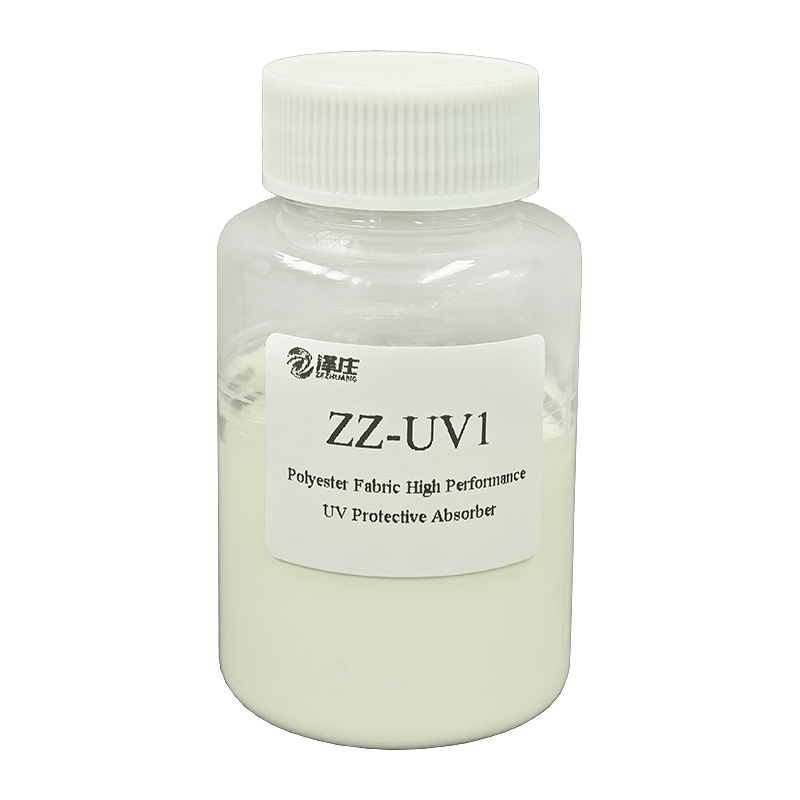
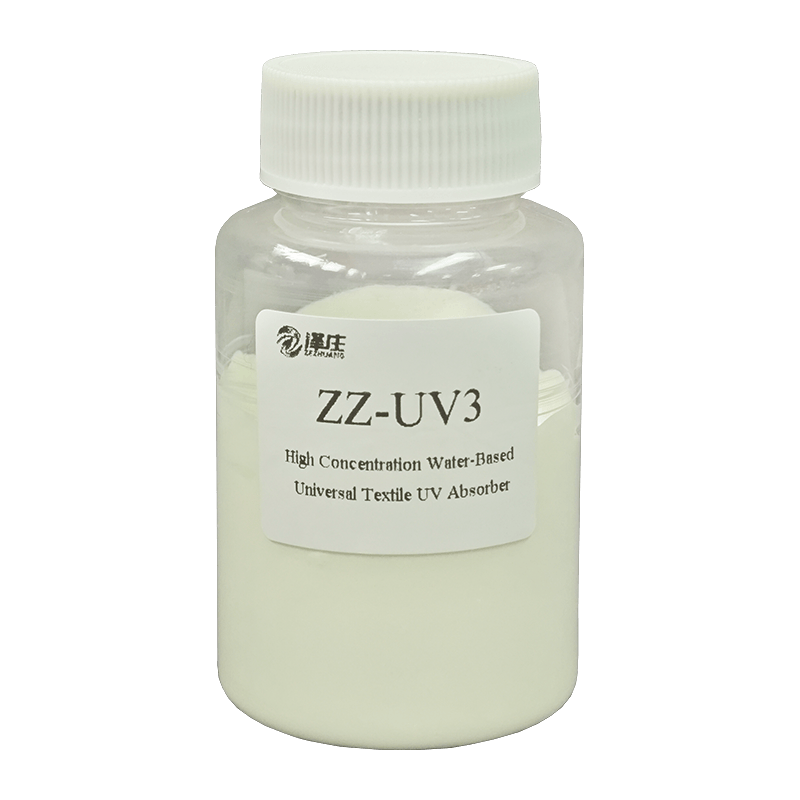
Hubei Zezhuang Technology Industrial Development Co., Ltd., with production bases in Hangzhou and Jingzhou, splits its UV absorber range by fiber chemistry for exactly this reason. The ZZUV5 grade is built specifically for ultra-thin nylon fabrics. For regular nylon constructions requiring high wash resistance, the ZZUV2 grade is available; while a high-concentration water-based grade such as ZZUV3 suits mills that want maximum flexibility in a single stock tank.
 ZZ-UV5 UV Absorber for Ultra-Thin Nylon FabricsFormulated for low-denier nylon, this absorber raises UPF on lightweight shells without adding weight. It offers wash durability, works in the dye bath, and minimizes shade change for UPF 40+ garments.View Product →
Pad-Dry-Heat-Set Sequence
Selection alone is not the entire answer. The application sequence determines whether the absorber lands on the filament or stays in the pad trough:
- Pre-treat the fabric to remove spin finish, oligomers, and residual oils.
- Pad with 1.0-1.5% o.w.f. at pH 5-6 with a wet pick-up of 70-80%.
- Dry at 120-130°C to fix the absorber before heat-setting.
- Heat-set at 170-180°C for 60-90 seconds without washing off.
Validation Tests That Predict Field Performance
Validation for lightweight textiles needs three endpoints: UPF after multiple washes, UV-B transmittance, and lightfastness after heat-setting. A single initial UPF reading is not enough, because bulk finishing lines vary in liquor pick-up and dryer temperature.
UPF 40+After 20 washes (AATCC 183)
<3%UV-B Transmittance after finishing
Grade 4Lightfastness (ISO 105-B02, 20 hrs)
≤1.0Yellowing Delta b* after heat-set
To ensure your bulk UPF ratings match the lab results, Zezhuang's in-house R&D and testing center performs rigorous UV-B transmittance and wash-durability checks before every shipment. Supported by long-term research cooperation with textile universities, we help mills avoid the costly mistake of failed UPF tests on finished garments.
FAQ: Ultra-Thin Nylon Fabric UV Absorbers in Production
What concentration of ultra-thin nylon fabric UV absorber should I start with?
Start at 1.0-1.5% o.w.f. for plain-weave nylon taffeta between 20 and 40 g/m². If the weave is dense or high-twist, reduce to 0.8%; if the fabric is a very open mesh, increase to 2.0% and verify UPF before scale-up.
Can the same UV absorber work on nylon and polyester?
No. Nylon and polyester have different terminal groups and surface charges. A product designed around nylon substantivity will exhaust poorly on polyester. Use a polyester-specific absorber for PET shells and a nylon-specific absorber for polyamide shells.
Will a UV absorber interfere with a fluorocarbon-free water repellent?
Generally no, if the absorber is an anionic or non-ionic dispersed formulation with a small particle size. To be safe, pad the UV absorber first, dry, then apply the repellent in a second pad bath so each chemistry forms its own film.
How do I detect UV absorber waste on my finishing line?
Check the wet pick-up and the pad trough concentration. If the fabric's theoretical add-on exceeds its actual pick-up, the pad nip is filtering out liquor. Calculate the expected add-on from wet pick-up and bath concentration, then compare the measured UPF to the lab result.
Protect Your Lightweight Fabrics Without Adding Weight
For 20D and 30D outdoor shells, fabric thickness cannot be compromised. A fiber-bonded UV absorber is the only way to achieve UPF 40+ durability without destroying breathability or hand feel.
If you are developing a new lightweight outdoor collection, our technical team can review your fabric specifications and recommend the ideal UV absorber for your dyeing and finishing process. Contact us here to request a sample of ZZ-UV5 or request a UPF testing consultation.