

 English
  Español
 Content
- 1 What Does Soft Hand Mean in Fluorine-Free Finishing?
- 2 Why the PFAS-Free Transition Is Now the Regulatory Baseline
- 3 How Fluorine-Free Soft-Hand Repellents Work on the Fiber
- 4 Performance Benchmark: Soft-Hand Fluorine-Free vs. C6 and C8 DWR
- 5 Choosing the Right Soft-Hand Fluorine-Free Water Repellent
- 6 Processing Guidelines: Protecting Softness and Spray Rating on the Line
- 7 Frequently Asked Questions
- 7.1 Can a soft-hand fluorine-free water repellent match C6 or C8 spray ratings?
- 7.2 What curing temperature does a soft-hand fluorine-free repellent need?
- 7.3 Do silicone-modified fluorine-free repellents cause spotting in the dyehouse?
- 7.4 Are renewable-content fluorine-free repellents durable enough for outdoor brands?
A water-repellent finish that leaves fabric stiff, boardy, and noisy fails the first test of garment quality. Yet that is what many mills have accepted when fluorinated DWR chemistries deposit a rigid film across yarn surfaces. With PFAS restrictions spreading from Europe to North America, brands and finishing plants must replace fluorinated chemistry without losing the soft, draping hand consumers expect from rainwear, footwear, and everyday outerwear. A modern soft-hand fluorine-free water repellent is designed to deliver both: durable water protection and comfort-grade flexibility.
What Does Soft Hand Mean in Fluorine-Free Finishing?
Soft hand in a treated fabric means the finish preserves drape, flexibility, smoothness, and compressibility close to the unfinished base cloth, and the most direct way to quantify it is bending stiffness.
Test labs measure bending length with a cantilever device under ASTM D1388. A standard 100-130 gsm untreated polyester or cotton fabric reads roughly 1.0-1.5 cm. A heavy fluorinated DWR treatment can push that value up by 2.2-2.6 times, which is why treated shells feel papery. A well-formulated soft-hand fluorine-free finish keeps the increase to about 1.2-1.5 times, a difference felt immediately in sleeve mobility, collar fold, and fabric sound.
Soft-hand water repellency is a finish that raises the liquid-water barrier of a textile while keeping the fabric's mechanical properties, drape, flexural rigidity, and surface friction, within comfort-acceptable ranges.
Soft hand is not just a preference. Fabrics with lower bending stiffness conform better to the body, pack more efficiently, and produce less seam puckering. In footwear, flexible uppers reduce crease cracking and walk-out stiffness in cold weather.
Why the PFAS-Free Transition Is Now the Regulatory Baseline
PFAS-free water repellents are no longer a voluntary sustainability option; they are the operating standard for textile exports to Europe and for a growing list of U.S. states.
The EU REACH restriction proposal published by ECHA covers around 10,000 PFAS substances, with phase-out schedules that could make fluorinated finishes commercially impractical within this decade. Maine and Vermont have enacted PFAS product bans; California's Safer Clothes and Textiles Act is pushing fluorinated finishes out of apparel. Oeko-Tex Standard 100 limits PFAS content, ZDHC flags them on its Manufacturing Restricted Substances List, and major outdoor brands have set 2025-2030 elimination targets.
Two consequences follow for a finishing unit. Chemical inventories must be revalidated against restricted-substance lists. A mill that postpones the switch keeps buying chemistry with a shrinking compliance horizon and rising testing risk.
10,000+PFAS substances in the EU proposal
2025-2030Elimination deadlines set by brands
120-130CLow-temperature F-free cure options
Switching chemistry is cheaper than defending a restricted substance. Finishing plants that treat PFAS removal as a supply-chain clearance task, not a product redesign, protect their export business in the same season the restriction is announced.
How Fluorine-Free Soft-Hand Repellents Work on the Fiber
Fluorine-free soft-hand finishes build a water barrier from low-surface-energy waxes, silicones, and dendritic crosslinked polymers that anchor to individual fibers instead of bridging them into a stiff shell.
Fluorinated finishes lower the surface free energy of a fabric to roughly 10-15 mN/m, which is what gives oil repellency on top of water beading. Fluorine-free systems use a different toolbox: paraffin waxes, siloxane polymers, fatty-acid-modified polyurethanes, and highly branched dendrimers. Each molecule carries a reactive anchor that bonds with hydroxyl, amino, or carboxyl groups on cotton, nylon, wool, or polyester.
- Paraffin lattices deposit microcrystalline hydrophobic particles that give good rain beading but a drier hand.
- Silicone-modified systems combine a siloxane softener backbone with hydrophobic side chains for a slick, supple touch.
- Dendrimer networks build three-dimensional crosslinked shells around each fiber and follow fiber flex through laundering.
- Blocked-isocyanate or silane crosslinkers lock these structures to the fiber and to each other during curing.
The key to soft hand lies in what does not happen. The chemistry coats fibers individually instead of filling the space between yarns, so inter-fiber bonding, the main cause of boardiness, is minimized. The fabric flexes as it did before finishing while the hydrophobic layer stays intact.
Dendrimer-based fluorine-free water repellency can be defined as a reactive, water-dispersed coating that renders individual fiber surfaces hydrophobic through branched polymer anchors while leaving inter-fiber voids open, preserving the fabric's original flexibility.
Performance Benchmark: Soft-Hand Fluorine-Free vs. C6 and C8 DWR
Compared with C6 and C8 fluorinated finishes, soft-hand fluorine-free systems trade oil repellency and a small margin of initial spray rating for lower stiffness, safer regulatory status, and increasingly competitive wash durability.
The table below summarizes typical dyehouse-level performance from commercial datasheets and independent textile testing on polyester and nylon outerwear fabrics.
| Property | C8 Fluorinated | C6 Fluorinated | Soft-Hand Fluorine-Free |
| Initial spray rating, AATCC 22 | 90-100 | 85-90 | 80-90 |
| Oil repellency, AATCC 118 | 6 | 5 | 1, water only |
| Bending stiffness increase vs. untreated | 2.2-2.6x | 1.8-2.2x | 1.2-1.5x |
| Spray rating after 20 launderings | 75-80 | 60-70 | 50-70 |
| Regulatory outlook | Banned or restricted | Restricted, reporting burden | PFAS-free, export ready |
Read the table the way a garment developer does. A program that requires oil repellency or an initial spray rating above 90 still depends on fluorinated chemistry. A program that needs rain protection, softness, breathability, and PFAS-free compliance can use soft-hand fluorine-free systems today.
Choosing the Right Soft-Hand Fluorine-Free Water Repellent
Selecting a soft-hand fluorine-free water repellent is a three-parameter decision: fiber chemistry, heat budget, and durability target, plus any renewable-content requirement set by the brand.
No single formulation covers every fabric. A low-temperature cure is essential for spandex blends; a high-temperature-stable system is needed for fabrics that pass through coating ovens; silicone modification is preferred when a slick hand is the priority. Matching the formulation to the process prevents both common failures: early spray-rating loss after the fifth wash, and a hand so hard that the order is rejected at the cut table.
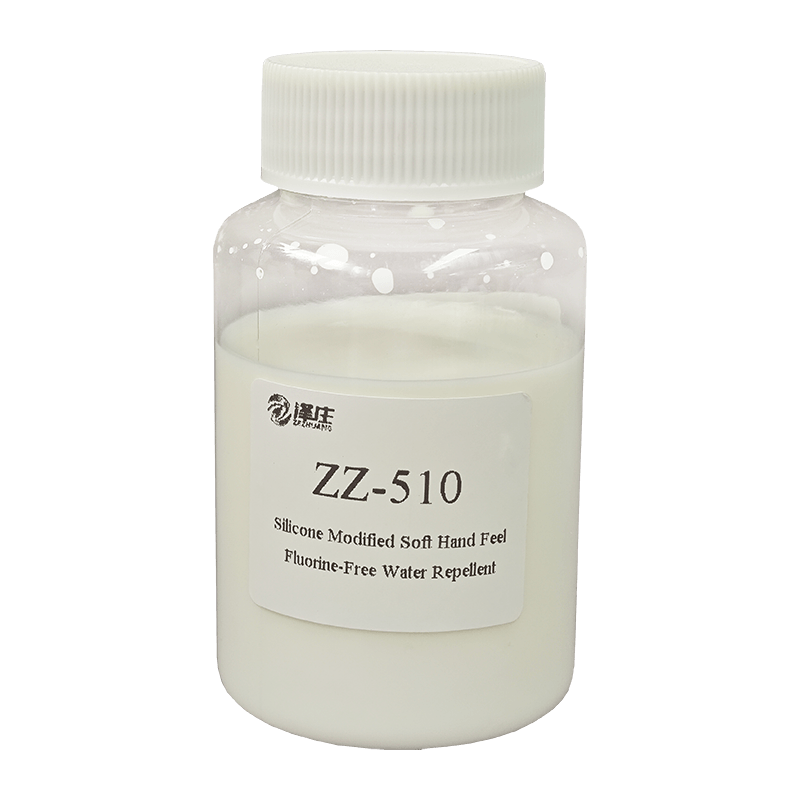 ZZ-510 Silicone Modified Fluorine-Free Water Repellent for Soft HandA silicone resin-based durable water repellent with a weak cationic nature, suited for wash-resistant finishing of nylon, polyester shells, and footwear linings where a supple touch and durable beading are required.View Product →
Best for nylon and polyester shells, footwear linings, and programs that require a softener-like supple touch with durable beading.
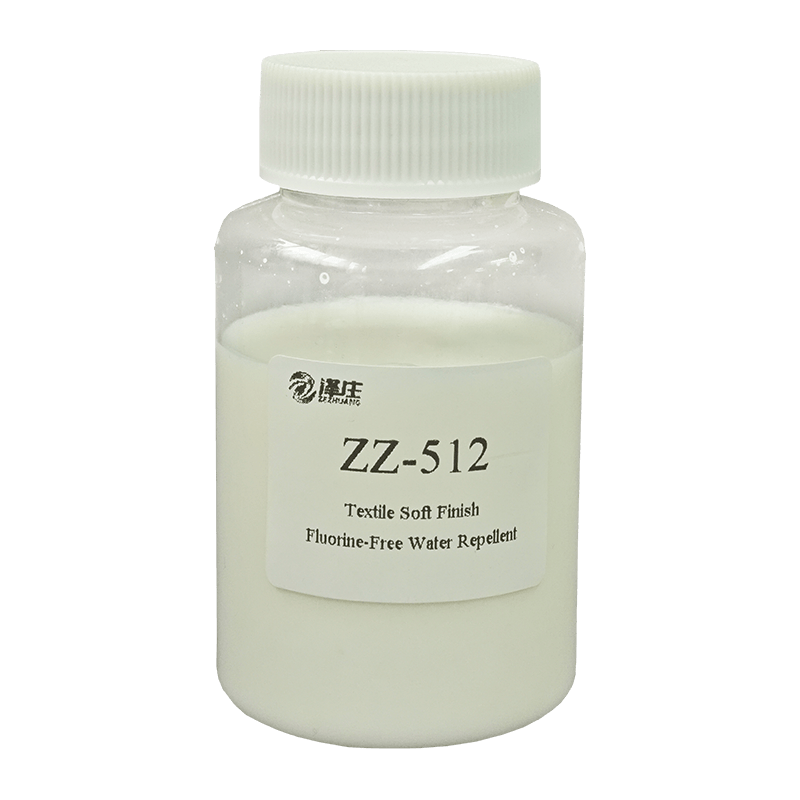 ZZ-512 Specially Modified Copolymer Water Repellent for Soft FinishA non-PFCs emulsion designed for fashion outerwear, shirts, and light jackets, offering balanced water repellency with a soft hand feel and improved fabric handling, ideal for spray ratings of 60-80.View Product →
Best for fashion outerwear, shirts, and light jackets with spray targets of 60-80 and a balanced soft-hand versus cost profile.
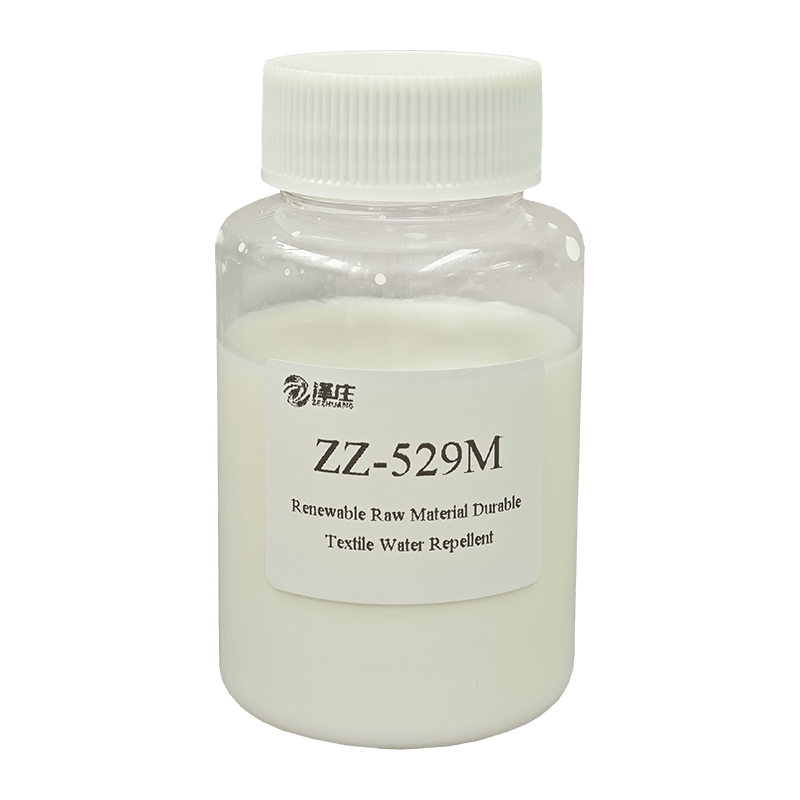 ZZ-529M Renewable Raw Material Durable Water RepellentA fluorine-free water repellent formulated with alkyl urea ester and renewable materials, providing wash-resistant waterproofing for textiles while supporting RSL-limited programs and brands seeking measurable bio-based content.View Product →
Best for RSL-limited programs and brands that require measurable renewable or bio-based content in the finish.
Keep these criteria in mind when reviewing a supplier proposal:
- Fiber type: cotton accepts wax and blocked-isocyanate systems; nylon and polyester respond best to silicone and dendrimer systems.
- Curing temperature: pick a low-temperature grade at 120-130C for spandex or breathable membranes.
- Durability: match wash-test protocol and target spray retention after 5, 10, or 20 launderings.
- Bath auxiliaries: check anionic and cationic compatibility with softeners and crease-resistant resins.
- Renewable content: request feedstock documentation if the brand requires minimum bio-based carbon.
This soft-hand fluorine-free range is manufactured by Hubei Zezhuang Technology Industrial Development Co., Ltd., a textile dyeing and finishing auxiliaries specialist with production in Zhejiang and Hubei.
Processing Guidelines: Protecting Softness and Spray Rating on the Line
The softest repellent chemistry will fail if the application recipe is wrong; pad pick-up, drying, curing, and mechanical finishing must each be controlled to preserve both performance and feel.
- Pad at 60-75% wet pick-up on a two-dip, two-nip applicator.
- Dry at 100-120C first; excessive pre-dry heat drives surfactants into uneven spots.
- Cure at 150-165C for 60-90 seconds; under-curing leaves the film water-soluble, over-curing adds stiffness.
- Control stenter overfeed so tension does not distort yarns during curing.
- Review calendering after curing; heavy pressure and heat crush the finish and cut spray ratings.
For a full accounting of how roller pressure, temperature, and throughput affect the hydrophobic layer, see our guide on preventing water-repellency loss during calendering.
In a typical dyehouse integration, the finish is applied in the last padder bath after washing and dye fixing. Most reactive soft-hand systems can be combined with a nonionic softener in the same liquor. Run a 30-minute bath stability test before production.
Dyehouse rule of thumb: if the dried but uncured fabric already feels boardy, the cause is wet pick-up or drying temperature, not the chemistry. Reproducible softness starts before the curing oven.
Frequently Asked Questions
Can a soft-hand fluorine-free water repellent match C6 or C8 spray ratings?
For water repellency alone, current fluorine-free systems reach initial spray ratings of 80-90 on polyester and nylon, versus 85-100 for C6 and C8. Wash durability has improved to a realistic 50-70 spray retention after 20 launderings with reactive dendrimer formulas. Oil repellency remains the gap: fluorine-free finishes do not repel oils, so oily-stain programs should keep fluorinated options or redesign the pack.
What curing temperature does a soft-hand fluorine-free repellent need?
Most formulations cure at 150-165C for 60-90 seconds. Low-temperature grades cure at 120-130C for spandex blends, silk, or dyed fabrics that cannot tolerate high heat. Confirm the exact window with the supplier before setting the stenter.
Do silicone-modified fluorine-free repellents cause spotting in the dyehouse?
Silicone softeners spot when over-applied or cured too fast. A well-formulated silicone-modified repellent is emulsified for bath stability; avoid spotting by drying below 120C before curing, keeping bath pH at 5-6, and cleaning the padder between runs.
Are renewable-content fluorine-free repellents durable enough for outdoor brands?
Yes, within defined limits. Renewable-content systems built on bio-based dendrimer or polyurethane backbones show wash durability comparable to conventional fluorine-free chemistry, often 70-80% spray retention after 20 launderings. Qualify the product on your actual fabric and wash protocol before scale production.
The move to soft-hand fluorine-free chemistry is now a supply-chain question. Mills that document formulations, curing profiles, and test data put themselves in the strongest position with export buyers and eco-certified programs.