

 English
  Español
 Content
- 1 Why PFAS-Free DWR Became the Standard for Outdoor Apparel
- 2 What Delivers Durable Water Repellency Without PFAS
- 3 How to Build Durability Into a Non-Fluorinated Finish
- 4 Comparing PFAS-Free and Fluorinated DWR Performance
- 5 Process Parameters That Decide Field Performance
- 6 Frequently Asked Questions on PFAS-Free Durable Water Repellency
By late 2025, the European Chemicals Agency's proposed REACH restriction on per- and polyfluoroalkyl substances - more than 10,000 compounds - had pushed textile finishing past the point of no return. State bans in California and the EU-wide restriction risk locking fluorinated DWR out of major markets. This article explains how durable water repellency without PFAS is achievable in daily production: the chemical families, the process conditions that make it last, and the spray ratings a finisher can honestly promise after 20 launderings.
Why PFAS-Free DWR Became the Standard for Outdoor Apparel
PFAS-based durable water repellents are being eliminated because their breakdown products (PFOA, PFOS and short-chain replacements) persist in groundwater, soil and human blood, and regulators have moved from voluntary phase-outs to binding legal limits. A durable water repellent finish, or DWR, is a chemical treatment applied to finished fabric that makes droplets bead and roll off while leaving air permeability intact.
The commercially critical word is "durable": how many wash cycles, rain events and abrasion passes the finish survives before a shell wets out. Ski jackets and trail shells are laundered aggressively; fluorinated topcoats tolerated 20 to 30 cycles. The distinction between water-repellent, water-resistant and waterproof matters here, because PFAS-free DWR is strictly a repellent finish and not a waterproof membrane. Selecting a product matched to your fibre and line conditions is the first durability decision.
EU REACH PFAS restriction: more than 10,000 fluorinated substances proposed for restriction. Mills without a validated alternative risk losing access to the European market for outdoor and sports textiles.
What Delivers Durable Water Repellency Without PFAS
Non-fluorinated DWR chemistry delivers water repellency through four families, each with a distinct balance of repellency, wash durability and hand feel: paraffin and metal-soap dispersions, modified silicones, polyolefin and acrylate dispersions, and reactive polyurethane or hybrid systems. The most reliable PFAS-free products combine a low-surface-energy polymer with reactive groups that bond to the fibre or to a co-applied crosslinker.
For water repellency, the physical target is a contact angle above 90 degrees; well-formulated non-fluorinated finishes reach 120 to 130 degrees on polyester and nylon, producing strong water beading. What they do not produce is oil repellency. No PFAS-free finish currently repels salad oil or sunscreen the way a C8 fluorocarbon did, and that single difference must be managed in product claims and care labelling.
| Chemical family | Water repellency | Wash durability | Hand feel |
| Paraffin / metal soap | Moderate | Low, 5-10 washes | Soft, waxy |
| Modified silicone | Good | Moderate, 10-20 washes | Very soft |
| Polyolefin / acrylate | Good | Moderate to good | Firm |
| Reactive polyurethane / hybrid | High | High, 20+ washes | Variable by formulation |
Working definition: Durable water repellency means a finished fabric retains a spray rating of at least 80 (ISO 4920) after a stated number of standard home launderings. For outdoor apparel, 20 washes is the current de facto industry benchmark; premium shell products aim for 30 to 50.
How to Build Durability Into a Non-Fluorinated Finish
Durability without PFAS rests on three mechanisms: crosslinking the repellent film to itself, reacting the finish with the fibre surface, and matching the polymer to the fibre and process. A reactive polyurethane or hybrid product cures into a three-dimensional network that locks around yarns, while a silicone modification keeps the film flexible so it survives repeated flexing and abrasion. For mills that must document renewable content in their supply chain, a renewable-raw-material formulation sustains the same wash durability while supporting sustainability reporting.
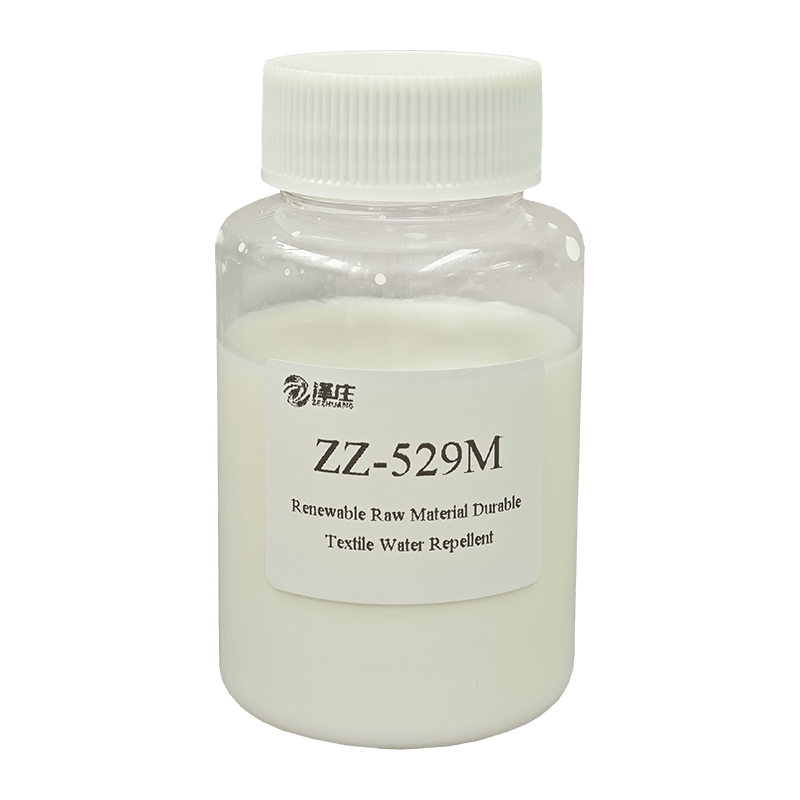 ZZ-529M Renewable-Source Fluorine-Free Durable Water RepellentThis alkyl urea ester emulsion uses renewable raw materials for wash-resistant waterproofing, supports sustainability reporting, and suits mills documenting renewable content. Its weak cationic nature and bluish tone are stated.View Product →
Specialty formulators such as Hubei Zezhuang Technology Industrial Development Co., Ltd. engineer these mechanisms into production-ready grades. Blocked isocyanate crosslinkers activate above 140 degrees C and typically add two to four extra wash cycles on nylon and polyester, while resin extenders stabilise the film on cotton-rich blends. When a soft, draping sportswear handle is the priority, silicone-modified fluorine-free products carry the softness while the reactive polymer carries the durability.
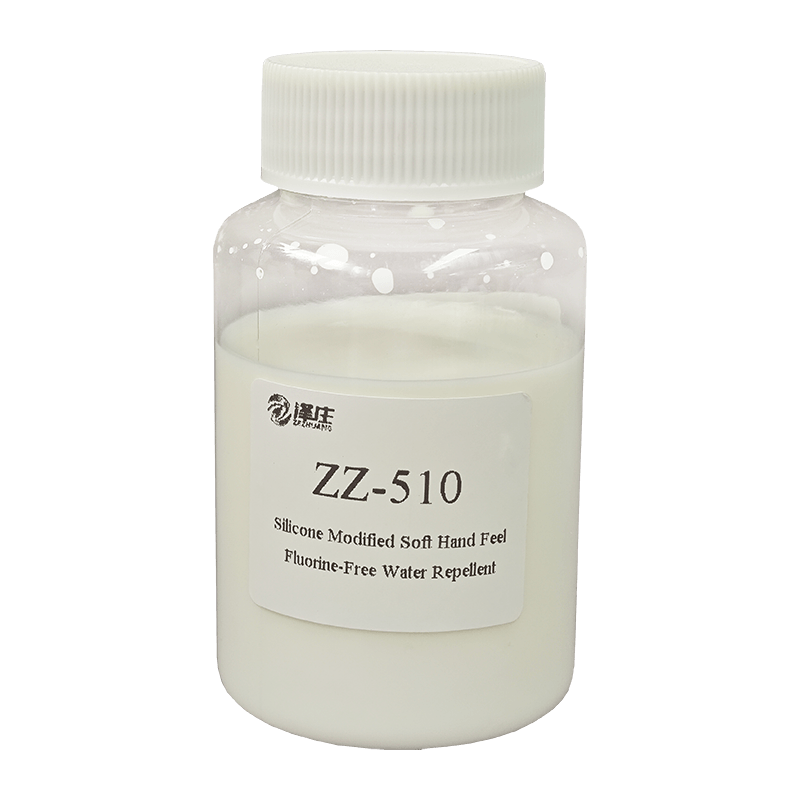 ZZ-510 Silicone-Modified Fluorine-Free Soft-Hand Water RepellentA silicone resin-based repellent that preserves a soft, draping sportswear handle while the reactive polymer supplies wash durability. Ideal for balancing hand feel with fluorocarbon-free performance.View Product →
Mills that sacrifice hand feel to chase repellency usually end up reworking both the finish and the garment. The right formulation balances the three targets together, not in sequence.
150-170 CCuring range for reactive non-fluorinated systems
+10 CAdditional cure heat can double wash durability
60-70%Recommended wet pick-up on nylon or polyester
Practical rule: If the cured fabric feels dry and papery, curing temperature is set too high for the binder system. If it beads water but loses beading after one wash, the finish is under-cured: increase dwell time or temperature in steps of 5-10 degrees C.
Comparing PFAS-Free and Fluorinated DWR Performance
Non-fluorinated finishes begin with a measurable disadvantage in initial spray rating, but the gap closes with washing because fluorinated films lose performance faster. In standard ISO 4920 spray testing, a C8-cured fabric starts at 100 and typically drops to 80 after 20 launderings; a well-built PFAS-free hybrid starts at 85 and reaches 75, and a budget polyolefin falls to 55.
Spray rating after 20 home launderings (ISO 4920, scale 0-100)
C8 fluorocarbon
C6 fluorocarbon
PFAS-free reactive hybrid
PFAS-free silicone-modified
PFAS-free polyolefin
Initial ratings: C8 = 100, C6 = 90, reactive hybrid = 85, silicone-modified = 85, polyolefin = 80.
The real trade-off is oil repellency. Rain still beads on a PFAS-free shell, but oily fingertips, insect repellent and sunscreen can spread and leave marks. Brands should therefore communicate what the finish cannot do as clearly as what it can.
| Property | Traditional C8 | C6 short-chain | PFAS-free hybrid |
| Initial spray rating | 100 | 90 | 85 |
| Spray rating after 20 washes | 80 | 70 | 75 |
| Oil repellency | High | Moderate | None |
| Breathability impact | Reduced by dense film | Minor | Preserved |
| Relative chemistry cost | High | Medium-high | Medium |
At 20 washes, a PFAS-free reactive hybrid trails a C8 system by only 5 spray points (75 versus 80), while a C6 system falls to 70. Durability engineering turns non-fluorinated from a compromise into a competitive finish.
Process Parameters That Decide Field Performance
Process control decides whether a PFAS-free product performs at its rated level, because non-fluorinated films are far more sensitive to application conditions than fluorocarbon melts were. Two mills can use the identical chemistry; one ships fabric that holds an 80 spray after 20 washes, the other ships fabric that wets out after five. Five parameters account for most field failures:
- Wet pick-up: keep padding at 60-70% on synthetics. Overwetting dilutes the film, thins the barrier and causes repellent migration to the dryer.
- Curing temperature and time: reactive systems need 150-170 C for 60-120 seconds to crosslink. Under-curing leaves a brittle film that washes away.
- Bath pH: adjust to 4.5-6.0 with acetic acid. Alkaline conditions hydrolyse the reactive groups before they reach the fibre.
- Water hardness: keep pad-liquor hardness below 50 ppm. Calcium and magnesium ions neutralise the anionic emulsifier and destabilise the bath.
- Drying profile: dry at 100-120 C before curing to stop migration, especially on air-permeable knit fabrics.
For lines that cure hot, or for fabrics heat-set after finishing, a non-fluorinated product resistant to 180 C and above prevents film yellowing and degradation.
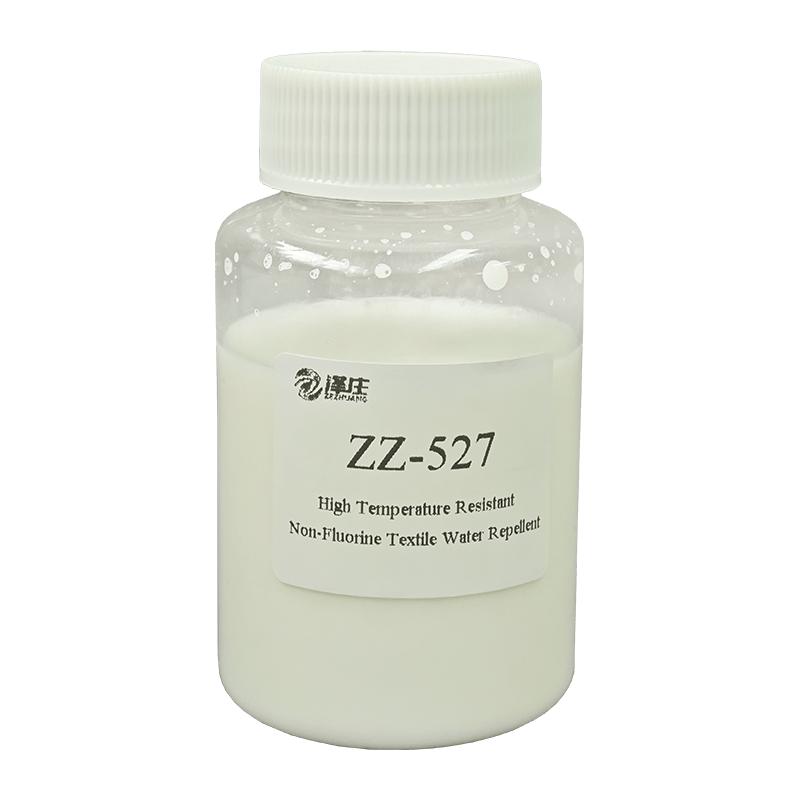 ZZ-527 Heat-Resistant Non-Fluorine Water Repellent for PolyesterAn acrylate-grafted polyurethane emulsion stable above 180 C, preventing yellowing and degradation during hot curing or heat-setting. Offers soft feel, anti-siphoning, and water bead bouncing for polyester.View Product →
A 10 C under-cure can cut wash durability in half. On a 60-second dwell line, raising the cure temperature from 150 C to 160 C usually adds five or more cycles of spray retention.
Frequently Asked Questions on PFAS-Free Durable Water Repellency
Is PFAS-free DWR as water repellent as fluorinated DWR?
In initial spray rating, no: a typical PFAS-free hybrid starts around 85 versus 90 to 100 for C6 and C8 systems. After 20 home launderings, the hybrid is often level with or ahead of C6 chemistry, because modern crosslinking systems lose performance more slowly in the wash.
How many washes can a PFAS-free finish survive?
A reactive polyurethane or hybrid system, correctly cured at 150-170 C, maintains a spray rating of 80 or higher for 20 to 30 standard launderings on nylon and polyester. Silicone-modified and polyolefin products deliver 10 to 20 washes and suit soft-shell or liner applications.
Do PFAS-free finishes affect breathability or hand feel?
PFAS-free films are generally thinner than fluorocarbon melts, so moisture vapour transmission is preserved. Hand feel depends on the polymer base: silicone-modified products add softness, while some hybrid systems need a softener co-additive to reach sportswear handle targets.
Can one PFAS-free formula cover polyester, nylon and cotton blends?
No single formula is optimal across all three. Nylon takes crosslinkers well but needs heat control; polyester requires higher curing temperatures; cotton-rich blends need an extender or a cotton-polyester-specific product to prevent the hydrophilic fibre from wicking.
Bottom line for finishers: Specify the target fibre, the wash-durability target, the cure temperature available on your line and the hand-feel requirement in the same sentence. A PFAS-free product selected against those four parameters will perform; one selected on price alone will not.