

 English
  Español
 Content
- 1 What a Textile Soft Finish Fluorine-Free Water Repellent Factory Controls
- 2 Five Numbers That Define Durable Soft-Finish C0 Performance
- 3 How Soft-Finish Fluorine-Free Water Repellent Formulations Differ by Fabric
- 4 Five Checks Before You Qualify a Textile Soft Finish Fluorine-Free Water Repellent Factory
- 5 Soft-Finish C0 Water Repellency: Four Answers Mills Ask Most
Most finishing trials fail before the fabric reaches the padder. When a dye-house shifts from a C8 fluorocarbon to a textile soft finish fluorine-free water repellent, the first batch usually shows one of two problems: the fabric feels boardy, or the spray rating collapses after the third wash. Both failures trace back to the same root cause - a generic C0 grade matched to the wrong polymer architecture. A textile soft finish fluorine-free water repellent factory does not sell one chemistry; it sells a series of polymer platforms tuned to fiber type, line speed, curing temperature, and a hand-feel target.
The buying decision is therefore not "does C0 work" but "which grade runs on my line." Soft-finish C0 grades differ in silicone content, crosslinker density, and curing window, which is why a textile soft finish fluorine-free water repellent factory publishes a portfolio instead of a single product. Mills that want a drop-in soft-finish C0 for blended apparel often trial a standard grade such as ZZ512 first, then move to fabric-specific variants once the baseline is established.
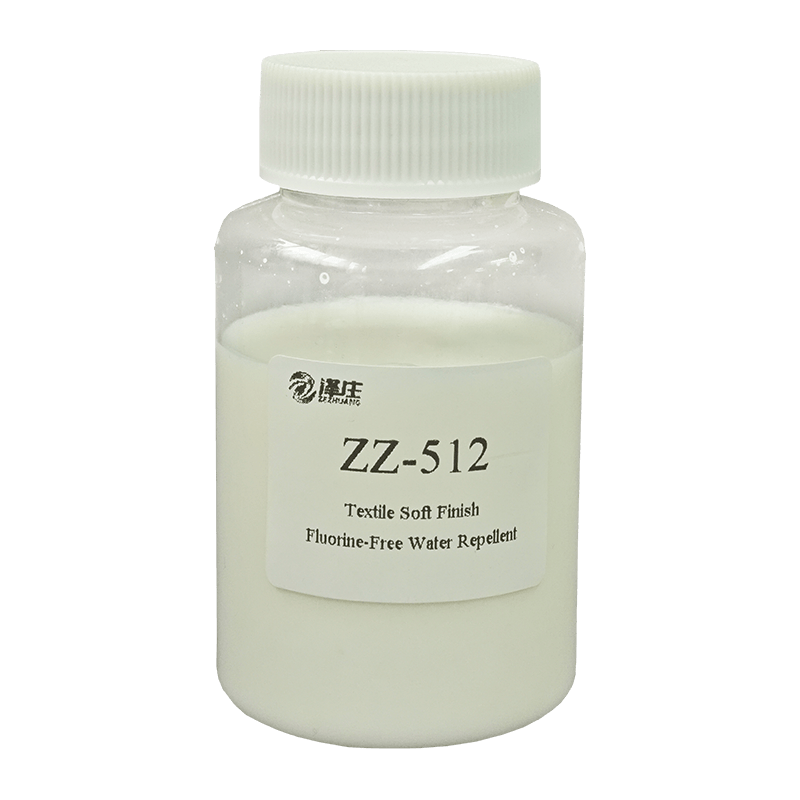 ZZ-512 Fluorine-Free Water Repellent with Soft FinishA weak cationic copolymer emulsion delivering water repellency and soft hand feel. Ideal as a baseline grade for blended apparel mills to trial before exploring fabric-specific variants.View Product →
A well-formulated C0 soft-finish grade should combine repellency and softness in one bath. Running a separate softener pass doubles chemical cost and line time.
What a Textile Soft Finish Fluorine-Free Water Repellent Factory Controls
A reliable factory controls three variables in every drum: the polymer backbone that determines hand feel, the crosslinking system that determines durability, and the process window that determines whether the chemistry survives your dryer.
Definition
Soft finish fluorine-free water repellent - a C0 (fluorine-free) finishing formulation that replaces fluorocarbon chains with hydrocarbon, silicone, or polyurethane polymers to create low-surface-energy coverage on the fiber while preserving a supple, flexible hand.
Fluorine-free repellents build water resistance through hydrocarbon waxes, silicone derivatives, or reactive polyurethane dispersions, and each family balances softness against durability differently. Hydrocarbon grades are durable but can stiffen the fabric. Silicone-modified grades, such as the factory's ZZ510 series, add a soft, slick feel while still sheeting water efficiently.
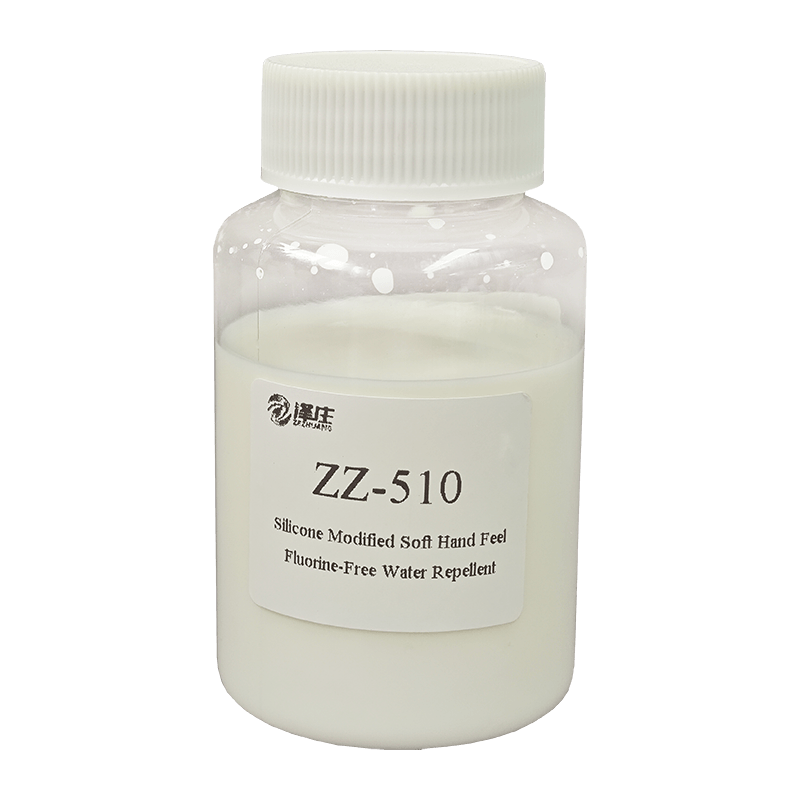 ZZ-510 Silicone-Modified Durable Water RepellentSilicone resin-based finish providing a soft, slick feel while sheeting water efficiently. Suitable for wash-resistant waterproofing of fabrics and nonwovens, miscible in water at any ratio.View Product →
The practical implication is measurable: a well-designed C0 soft-finish formulation should not require a second softening pass. Running a separate softener costs line time, water, and energy; a factory-grade product is expected to combine both functions in one pad batch.
90+Initial spray rating, ISO 4920
80+Spray rating after five washes
0.5Max acceptable hand-feel shift
140-170CTypical curing window by grade
Five Numbers That Define Durable Soft-Finish C0 Performance
Every durable C0 formulation can be summarized by five numbers; if a supplier cannot state them in writing, the trial results are not comparable across batches.
These figures are measured under ISO conditions, not on a hand swatch in an office. The same product can look entirely different when laundered per ISO 6330 and spray-rated per ISO 4920. That is the difference between a marketing claim and a factory-signed specification sheet.
| Performance parameter | Test method | Factory acceptance threshold |
| Initial spray rating | ISO 4920 | 90 or higher after 24 h conditioning |
| Spray rating after five washes | ISO 4920 plus ISO 6330 | 80 or higher for durable grades |
| Hand-feel shift vs current finish | Panel grading, 1 to 5 | No more than 0.5 grade, softer preferred |
| Curing temperature window | Lab pad-dry-cure trials | Within 10 degrees Celsius of stenter set point |
| Bath and foam stability | 60 min static bath test | No separation, no scum, no settling |
Spray rating retention of a durable soft-finish C0 grade over 20 wash cycles, ISO 4920 / ISO 6330.
The number that separates a good C0 from a merely soft one is the delta between the initial spray rating and the five-wash value. A drop of more than 10 points usually indicates insufficient crosslink density for your curing temperature.
How Soft-Finish Fluorine-Free Water Repellent Formulations Differ by Fabric
Fiber type decides polymer architecture: nylon needs a heat-reactive grade that cures below its softening point, polyester tolerates high-temperature curing, cotton and blends need crosslinkers that survive resin systems, and spandex blends require low-temperature film flexibility.
Choosing among these families follows the same logic as selecting a water-repellent agent for your dye factory: define the fabric, the process, and the durability target before opening a technical datasheet.
Nylon and polyester: match the curing window
Nylon's glass-transition zone sits far below polyester's. A grade built for 170 C polyester curing will over-cure on nylon, producing a hard film and poor spray ratings. Conversely, a low-temperature grade run on a polyester stenter may not fully crosslink, so the finish washes out. This is the single most common C0 failure in mills.
Cotton and blends: protect the crosslinker
Cotton and cotton-polyester blends are usually finished with resin, softeners, and wrinkle-free chemistry in the same bath. The C0 emulsion must survive low pH, catalysts, and competing auxiliaries. For this reason, mills running blended fabrics should choose a grade explicitly formulated for cotton-rich substrates, such as ZZ528.
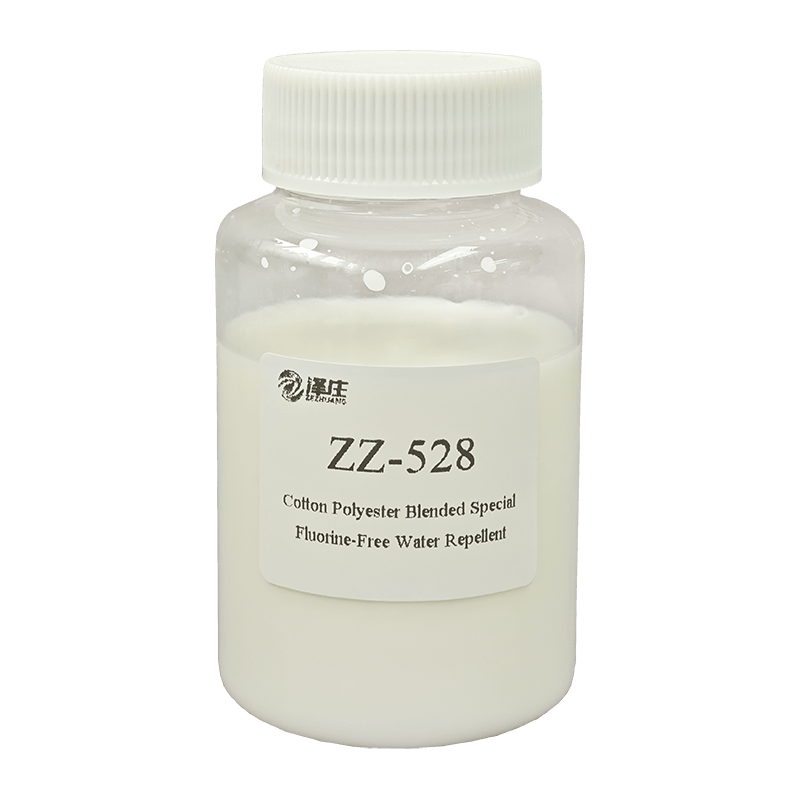 ZZ-528 Blended Fabric Fluorine-Free Water RepellentAn acrylate polymer formulated for cotton-polyester blends, compatible with common auxiliaries and low pH baths. Offers excellent low-concentration performance and can extend fluorinated repellents as a cost-reducing filler.View Product →
| Fabric and process condition | Recommended grade family | Main risk to manage |
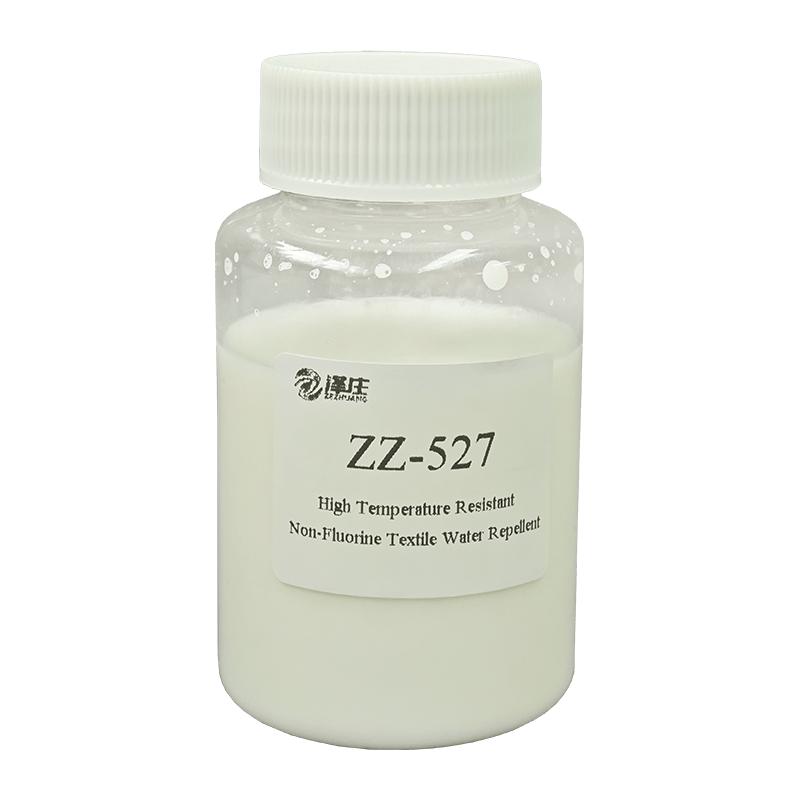
| Polyester, curing above 160 C | High-temperature-resistant C0 (ZZ527) | Over-crosslinking and stiff hand |
| Cotton-polyester blends in a resin bath | Blend-specific C0 (ZZ528) | pH shock and emulsion break |
| Knit apparel with soft-touch requirement | Silicone-modified C0 (ZZ510) | Thin-film durability |
| General pad-dry-cure soft finish | Standard soft-finish C0 (ZZ512) | Wash-down on dense weaves |
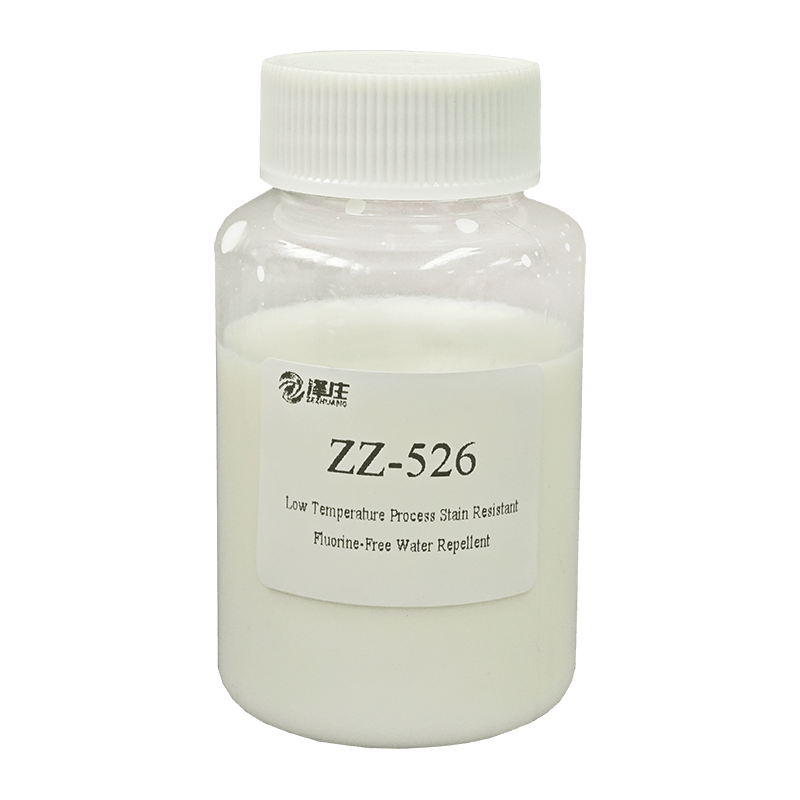
| Spandex or low-temperature lines | Low-temperature C0 (ZZ526) | Incomplete crosslink below 130 C |
Durability-first formulation
Higher crosslinker density for industrial wash standards
Tenacious film, slightly fuller hand
Better for workwear, outerwear, and frequent laundering
Hand-feel-first formulation
Silicone-modified backbone for drape and slip
Softer touch, lower extreme wash durability
Better for knitwear, fashion, and sensitive skin contact
If the fabric feels like cardboard after finishing, you are looking at the wrong polymer, not at a failed concept. Switch the grade family before you switch the repellent.
Five Checks Before You Qualify a Textile Soft Finish Fluorine-Free Water Repellent Factory
Qualify the factory, not just the sample: process audits beat brochures, and written specifications beat verbal reassurances.
Specialist suppliers such as Hubei Zezhuang Technology Industrial Development Co., Ltd., with dedicated R&D and testing centers, can answer all five checks below. If a supplier hesitates on any of them, treat the trial as unverified.
Audit the polymer platform. Self-emulsified grades with adjustable solids and pH behave differently from re-packaged concentrates.
Demand ISO-conditioned wash data. Ask for spray ratings at 0, 5, 10, and 20 washes, laundered per ISO 6330.
Verify the curing envelope. Compare the grade's documented curing range against your stenter set points before running the trial.
Check the documentation. Fluorine-free declarations, safety datasheets, and lot traceability must accompany every batch; compare them with the factory's washing-off auxiliary range.
Run a closed-loop plant trial. Measure hand feel, spray rating, and shade change before and after, on the actual production fabric.
What a factory should send before a trial
- A signed specification sheet with solids content, pH, and ionic character
- Wash-cycle spray ratings generated under ISO conditions
- A curing-temperature curve with recommended time windows
- Compatibility notes for resin, softener, and wrinkle-free baths
- A reference list of comparable mills running the same grade
Soft-Finish C0 Water Repellency: Four Answers Mills Ask Most
Does a soft-finish fluorine-free water repellent match C6 durability?
A well-constructed C0 grade reaches 80+ spray rating after five washes on most synthetics, against roughly 85-90 for a heavy C6 build. For industrial workwear and outdoor brands, the gap is shrinking as polyurethane and hybrid chemistries mature; for luxury fashion and knitwear, C0 is already the standard.
What curing temperature does a typical C0 soft-finish grade need?
Most pad-dry-cure grades crosslink between 140 C and 170 C for 60 to 90 seconds. If your line runs below 130 C, choose a low-temperature grade; running a standard grade below its cure window is the fastest route to poor wash durability.
How do I verify the supplier is truly fluorine-free?
Ask for a fluorine-free declaration on company letterhead, review the raw-material SDS for perfluorinated substances, and test the finished fabric with a total fluorine method such as ion chromatography after asking the supplier which standard they follow.
Can one grade cover garments, footwear, and industrial fabrics?
No. Shoe materials require anti-wicking behavior and abrasion resistance, which is why footwear-specific grades such as ZZ523H exist. Treat the C0 portfolio as a selection system, not a single SKU.
The shared rule across all C0 grades: softer is not always better. Softness that comes at the cost of crosslink density will fail your wash test.