

Content
- 1 Why Residual Oil Causes Uneven Dyeing on Polyester
- 2 What a Polyester Fabric Dyeing Special Degreaser Must Deliver
- 3 General Scouring Agent vs. Dyeing-Specific Degreaser
- 4 How to Run the Degreasing Process in a Dye House
- 5 Matching a Polyester Fabric Dyeing Special Degreaser to Fiber Type and Oil Load
- 6 Frequently Asked Questions
- 7 The Path to Zero Shade Rejects
A 2,000 kg batch of polyester interlock has just finished an exhaust dye cycle at 130°C. The operator pulls a sample, and the shade reads true except for scattered white marks that never accepted the dye. The recipe, the water chemistry, and the machine profile all check out. The real cause sat on the fiber before the bath was even prepared: oil.
Polyester yarn arrives with spin finish, knitting oil, and handling grease from upstream production. Because polyester is hydrophobic, those oils cling to the fiber surface and resist water-based chemistry. During dyeing, the film blocks dye molecules from adsorbing onto the fiber, producing pale spots, streaks, and blotchy shade. A polyester fabric dyeing special degreaser solves the problem at its source: it lifts the oil off the fiber, emulsifies it into the bath, and holds it suspended so the dye reaches every fiber uniformly.
The job differs from general scouring. An effective dyeing degreaser must work inside the dye-cycle temperature window, coexist with disperse dyes, and leave no residue that disturbs level dyeing. Fabric that carries oil into the bath produces defects that no amount of extra dye corrects.
Why Residual Oil Causes Uneven Dyeing on Polyester
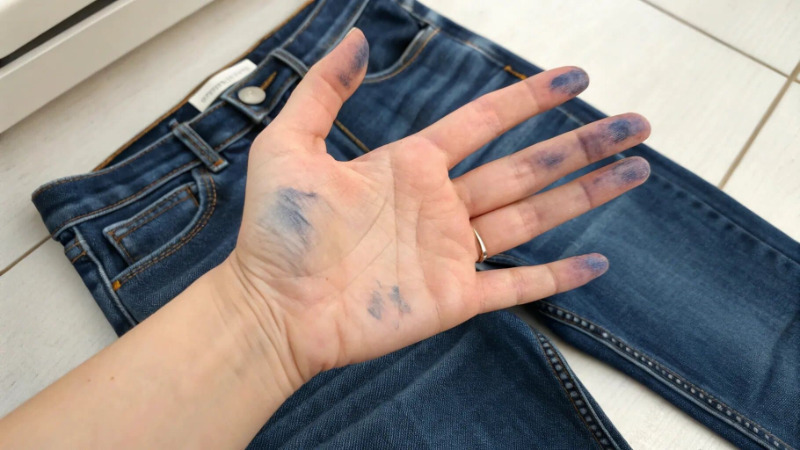
Residual oil prevents dye molecules from contacting the fiber, so every oily patch becomes a low-uptake zone that appears as a lighter spot, white mark, or muted streak after dyeing.
Fiber producers apply spin finish to drawn polyester yarn for lubrication and static control, typically 0.3–0.8% by weight; warp-knitting adds another film of machine oil. These oils contain base stocks, emulsifiers, and antistatic additives that do not dissolve in water. Alkaline scouring below 80°C does not fully split the oil film from a hydrophobic fiber.
At dyeing temperature the problem becomes more aggressive. Heat lowers the viscosity of the oil, so it migrates, smears across yarn bundles, and can redeposit onto previously clean fabric during the cooldown phase. This is why fugitive oil marks often show up in the middle of a roll rather than only at the edges.
0.3–0.8%Typical spin finish load on drawn polyester yarn
0.2%Residual oil that can leave a visible resist mark
80–100°CEmulsion release window before dyeing
Even a 0.2% residual oil film can act as a resist and create a visible defect after dyeing.
What a Polyester Fabric Dyeing Special Degreaser Must Deliver
A dyeing-special degreaser for polyester must remove oil during bath heat-up, keep the oil stably emulsified through the dye phase, and leave zero residue that interferes with dye uptake.
Unlike commodity wetting agents, a dyeing degreaser is built around process chemistry. It pairs non-ionic ethoxylated surfactants with selected anionic components to lower the interfacial tension between oil and water at 80–130°C. Emulsifier molecules surround each oil droplet and form micelles small enough to stay suspended; if they collapse, the oil floats to the surface and drops back onto the fabric.
- High emulsifying capacity in the 80–100°C release window
- Low-foam behavior that keeps pump circulation stable
- No precipitation with disperse dyes, leveling agents, or pH buffers
- Emulsion that stays stable through cooldown, preventing re-deposition
- Works in both one-bath and pre-scour routes
Emulsification window
The temperature range during bath heat-up in which the degreaser lifts oil from the fiber and locks it into the water phase before the dye exhausts onto the fabric.
For standard polyester knit and woven goods, Hubei Zezhuang Technology Industrial Development Co., Ltd. formulates the ZZ6150R polyester fabric dyeing special degreaser around this exact window. Manufactured in their Hangzhou and Jingzhou production bases, this concentrated surfactant blend handles typical spin-finish loads in a one-bath route without precipitating with disperse dyes.
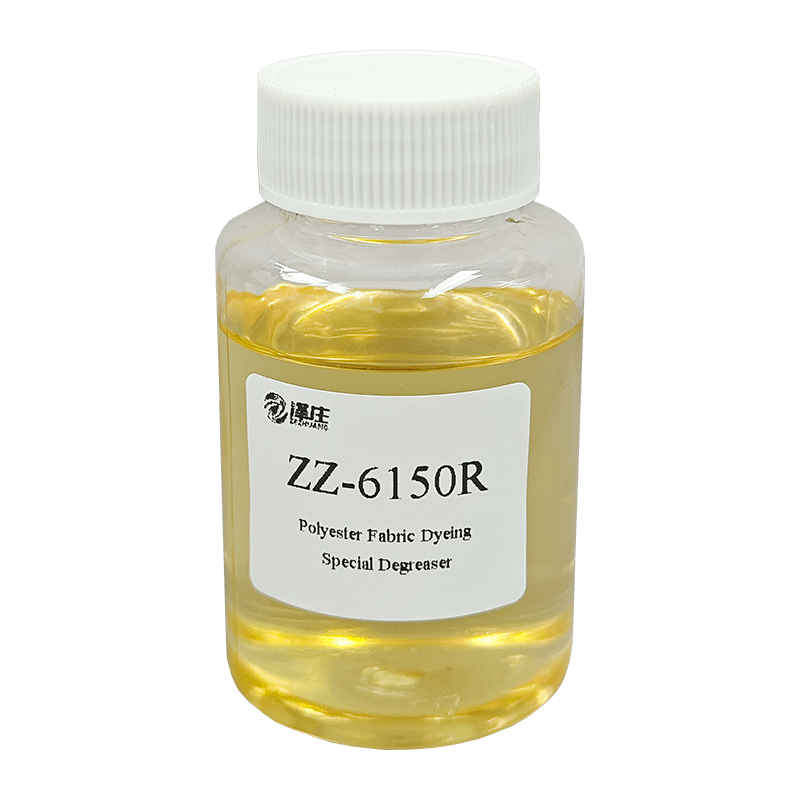 ZZ-6150R Polyester Fabric Dyeing Special DegreaserThis concentrated nonionic/anionic degreaser is designed for one-bath polyester dyeing, offering dispersion, chelation, and low foam to keep the bath clear and prevent color speckles.View Product →
Compatibility With the Dye Bath
The greatest process saving comes from dropping the degreaser straight into the dye bath. The product must not shift pH outside 4.0–5.5, must not precipitate with dye dispersion, and must not foam enough to starve pump circulation. A well-designed degreaser makes the bath clear and homogeneous within the first ten minutes.
General Scouring Agent vs. Dyeing-Specific Degreaser
A general scouring agent cleans dust and water-soluble impurities at moderate temperature; it is not engineered to carry oils through a dye cycle. Dye houses sometimes substitute a regular scouring agent to cut cost. The risk is redeposition: oil is loosened but not strongly emulsified, so it returns to the fabric during rinse or cooldown, producing a defect pattern worse than the original stain.
Risk Alert: Releasing oil without emulsifying it is a setup for redeposition. Unlike general scouring agents, a dedicated dyeing degreaser must keep the oil locked in suspension all the way to 130°C and through the cooldown phase until the bath is drained.
The preparation step also shapes the final fastness profile, because clean fiber takes dye evenly and fixation improves. Consistent preparation directly protects the color fastness of the finished fabric.
How to Run the Degreasing Process in a Dye House
The most reliable route is a one-bath process: dose the degreaser first, heat through the emulsification window, and continue to 130°C for a standard disperse dye cycle.
- Inspect the greige for visible oil marks, especially on interlock, fleece, and compacted knits.
- Dose the degreaser before any other chemical; 1.0–2.0 g/L for a medium spin-finish load.
- Circulate at 40–60°C for five minutes to wet out the yarn.
- Heat through 80–100°C and hold for 10–20 minutes to emulsify the oil.
- Keep liquor circulation constant during the whole hold.
- Confirm bath clarity, then ramp to 130°C and run the dye program.
For greige with heavy oil contamination, a one-bath dose may not be enough. Fabric stored long, processed with multiple passes, or reworked carries more oil than the window can emulsify. A pre-scour at 100–110°C with a high-concentrated heavy-duty textile degreaser (such as Zezhuang's ZZ6106H) removes the oil before the dye enters the machine.
A single 10–20 minute hold at 80–100°C is what turns a wet textile into an oil-free dyeing substrate.
Matching a Polyester Fabric Dyeing Special Degreaser to Fiber Type and Oil Load
The correct degreaser grade depends on the oil load, the fiber blend, and whether the process can accept a pre-scour step.
Standard polyester single jersey, interlock, and woven fabrics with ordinary spin finish run well in a one-bath route with a dedicated degreaser. Heavily soiled goods need a higher concentration. Polyester-spandex blends deserve separate attention: spandex releases its own oil during heating, and the degreaser must handle both fiber types without degrading elasticity.
For spandex-containing goods, chemistry shifts because elastic yarn loses strength above roughly 120°C and cannot tolerate aggressive alkalinity. Zezhuang's ZZS757 spandex-blended fabric high-efficiency degreaser keeps the bath gentle enough to protect elasticity while pulling methyl silicone oil from both fiber surfaces.
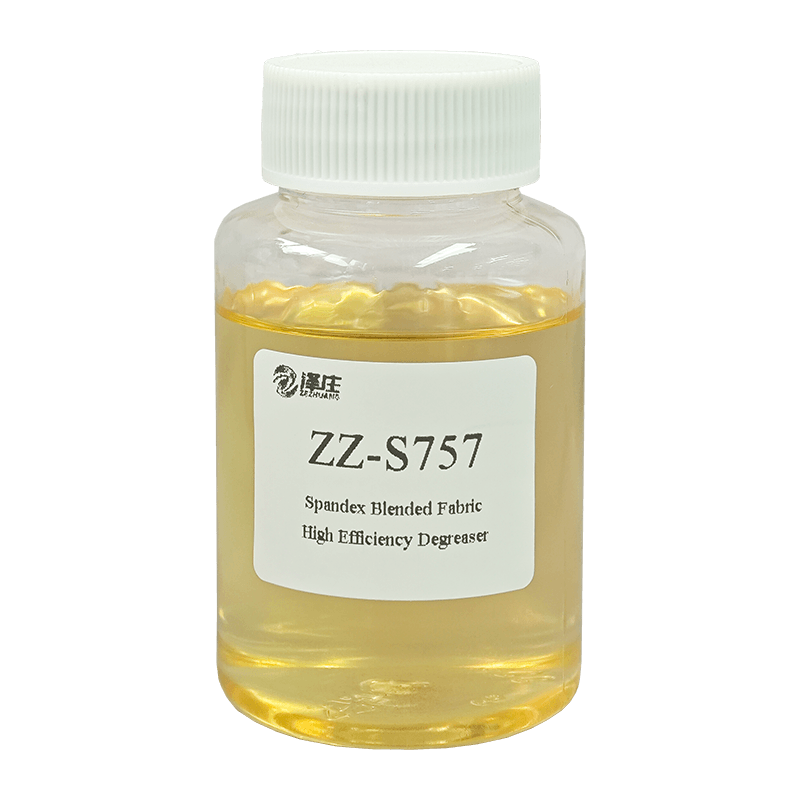 ZZ-S757 Spandex Blended Fabric High Efficiency DegreaserA gentle yet powerful degreaser for spandex blends, effective at 70–100°C, removing methyl silicone oil without harming elasticity, suitable for one-bath degreasing and dyeing.View Product →
Oil removal efficiency on soiled polyester greige
In practice this efficiency gap translates directly to yield. Fabric that carries 0.2% residual oil into the dye bath has a measurable chance of resist spots across the batch; removing that oil before dyeing eliminates the most common cause of shade rejects.
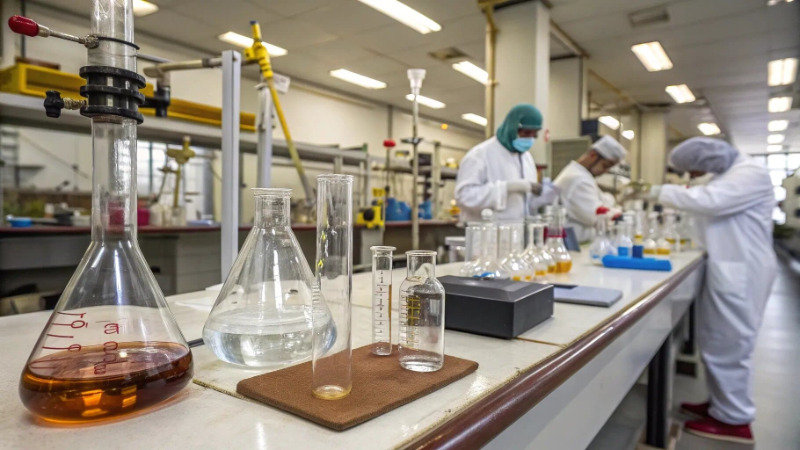
To ensure batch-to-batch consistency and protect your dyeing yield, Zezhuang's in-house testing center evaluates emulsion stability and compatibility before every shipment. A clean substrate is the cheapest quality insurance a dye house can buy, and reliable auxiliaries are the foundation of that process.
Frequently Asked Questions
What temperature should be used when degreasing polyester before dyeing?
Hold the bath at 80–100°C for 10–20 minutes to open the emulsion window, then continue to 130°C for the disperse dye cycle. Pre-scour routes run at 100–110°C for heavily soiled greige.
Can the degreaser be combined directly with disperse dyes in one bath?
Yes, when the product is a dyeing-special degreaser. It must be non-precipitating, low-foaming, and pH-compatible; add it first, circulate briefly, then heat through the window before dosing dyes and leveling agents.
Why do white oil spots still appear after degreasing?
Either the degreaser was underdosed, the 80–100°C hold was shortened, or the oil load exceeded the one-bath dose. Check the greige first; heavily oiled goods need a pre-scour with a heavy-duty degreaser.
Does every polyester batch need a separate degreasing step?
Not if the degreaser is compatible with one-bath dyeing. For standard, clean polyester, a single bath that includes the degreaser, the heat-up hold, and the dye phase is sufficient and saves time, water, and energy.
The Path to Zero Shade Rejects
Oil removal must happen before dye uptake, not after. The 80–100°C emulsification window is the moment that decides the final shade. By choosing a dyeing-special degreaser that matches your specific fiber load and machinery profile, dye houses can eliminate white spots and color rejects from their production line.
Hubei Zezhuang Technology Industrial Development Co., Ltd. supports dye houses with a dedicated R&D team, production bases in Hangzhou and Jingzhou, and technical cooperation with leading textile universities. If your team is experiencing stubborn oil spots or wants to optimize your one-bath dyeing process, our technical specialists are ready to review your recipe and recommend starting formulations. Contact us here to request a sample or technical datasheet.