

 English
  Español
 Content
- 1 Process Map What Textile Leather Auxiliaries Cover at Each Stage
- 2 Step 01 Degreasing: The Textile Leather Auxiliary That Protects Every Downstream Step
- 3 Step 02 Leveling and Fixation: The Chemistry Behind Uniform Leather Color
- 4 Step 03 Functional Finishing Auxiliaries: Water Repellency and UV Resistance on Leather
- 5 Dosing Building a Reliable Textile Leather Auxiliary System
- 6 FAQ Frequently Asked Questions About Textile Leather Auxiliaries
Textile leather auxiliaries are specialty chemical formulations that control degreasing, leveling, color fixation, water repellency, and UV stability throughout leather processing and finishing. A tannery that manages these chemistries correctly can hold batch-to-batch color tolerance below half a shade; one that does not inherits every downstream rework as its own operating cost.
Consider a production case seen in many tanneries. A plant processing sheep leather for an automotive interior supplier ran the same acid dye recipe across three consecutive batches and produced three visibly different shades. The dye lot was identical, and the wet-blue input sat within specification. The only variable was a drift in the neutralizing bath pH before dyeing, which shifted the leather's isoelectric point and changed how quickly the acid dye attached to the fiber. A correctly dosed leveling agent absorbs that drift. Without one, a small pH change turns into a costly color rejection.
3.2-3.8pH fixation window for acid dyes
1:3-1:5Float ratio for drum dyeing
45-50 deg COptimal degreasing temperature
+/-0.2%Dosage accuracy for shade repeatability
Process Map What Textile Leather Auxiliaries Cover at Each Stage
Textile leather auxiliaries are not a single product category. They are a family of chemistries, each aligned to a specific process stage. The classification below follows the order of an actual leather production line, from incoming wet-blue to finished hide.
- Soaking and degreasing agents - remove residual natural fats and processing oils before dyeing
- Leveling agents - slow dye strike and equalize shade across the full fiber surface
- Acid color-fixing agents - insolubilize dye molecules for higher wet and rub fastness
- Softening and fatliquoring agents - restore flexibility and tensile strength after retanning
- Water repellents and UV absorbers - deliver the final end-use performance specification
Definition: Textile leather auxiliaries are specialty chemicals used in leather production that modify how water, dyes, fats, and polymer coatings interact with the collagen fiber matrix, in order to achieve a controlled processing result or a required end-use performance.
Zezhuang supplies these auxiliary families across the full leather processing chain. The company's predecessor, Shanghai Zezhuang Industrial Co., Ltd., was founded in 2011, and today Zezhuang operates production bases in Hangzhou, Zhejiang and Jingzhou, Hubei, with its export arm Zhejiang Yongshuo Import & Export Co., Ltd. handling overseas market development.
| Process stage | Auxiliary family | Primary function |
| Wet-blue preparation | Degreasers, wetting agents | Remove residual fats, improve float penetration |
| Neutralization and retanning | Buffers, syntans | Adjust pH, open the fiber structure |
| Dyeing | Leveling agents, acid fixing agents | Uniform shade, high wet fastness |
| Fatliquoring | Softening agents | Restore flexibility and tensile properties |
| Spray and curtain finishing | Water repellents, UV absorbers | Water resistance, lightfastness |
Step 01 Degreasing: The Textile Leather Auxiliary That Protects Every Downstream Step
Degreasing quality controls the entire downstream result in leather processing. Residual fat in wet-blue leather ranges from roughly 1% to 8% depending on animal source, rawhide quality, and liming efficiency. When natural fat remains on the fiber surface, it blocks water penetration, causes dye to strike unevenly, produces oily spots under spray finishing, and weakens the adhesion of the final coating.
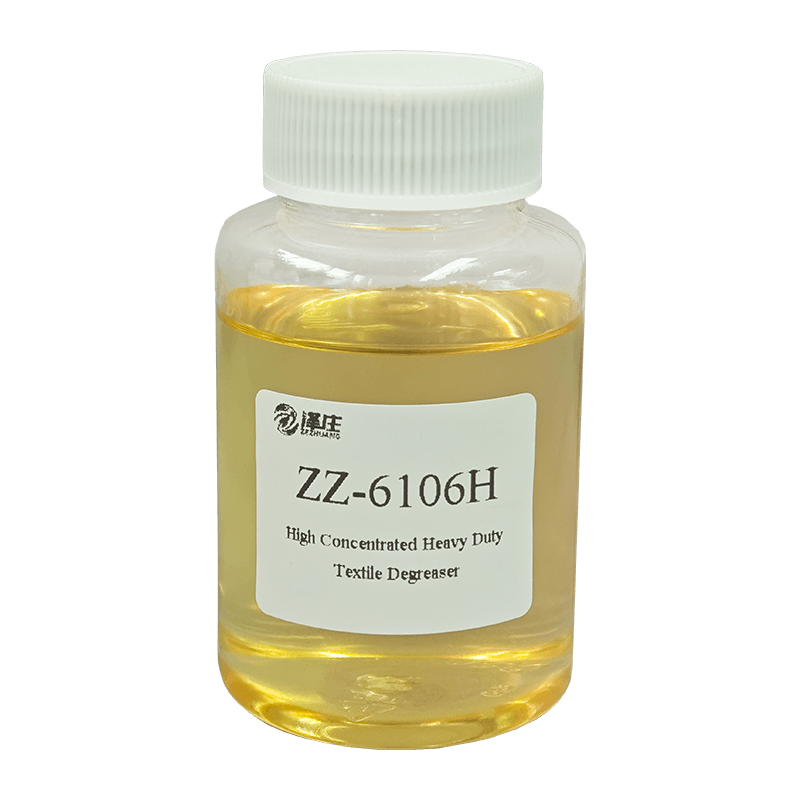
Three degreaser families dominate the industry. Solvent-containing degreasers penetrate quickly and handle heavily fatty hides. Surfactant-based degreasers place a lower load on wastewater and release fewer volatile organic compounds. Enzyme-assisted systems suit sheep and goat leather where collagen damage must be avoided. For most wet-blue and crust lines, the practical solution is a high-concentrated heavy-duty degreaser that removes emulsified oil in a single pass. A deeper breakdown of auxiliary classes and their working mechanisms is available in this comprehensive textile auxiliaries guide.
Zezhuang's degreaser line is produced at its Hangzhou and Jingzhou plants, with batch testing before shipment to keep emulsification performance consistent across lots.
Step 02 Leveling and Fixation: The Chemistry Behind Uniform Leather Color
Leveling agents and acid color-fixing agents are the two chemistries that decide whether a leather batch comes out uniform in shade and stable under wet conditions. Acid dyes bind to amino groups in collagen at acidic pH, but the binding is fast and temperature-sensitive. Without a leveling agent, the dye strikes first at the edges and grain surface, leaving a pale core. Tanneries producing automotive leather report that this ring-dyed cross-section is a common cause of dyeing rework.
After the target shade is confirmed, an acid fixing agent complexes the dye inside the fiber into a larger, water-insoluble structure that resists washing, perspiration, and wet rubbing. For acid dye systems on leather, and for the wool, nylon, and silk components used in leather-lined garments, a formaldehyde-free fixing agent raises wet rub fastness to 4.0 or higher in standard drum tests.
When to add the fixing agent: only after the dyebath is exhausted and the shade matches the standard. Adding a fixative early locks dye into the surface, producing a darker but poorly penetrated result that fails crocking tests.
| Defect | Root cause | Auxiliary solution |
| Uneven shade across the batch | Rapid dye strike, pH drift | Leveling agent at 1.0-1.5% on wet-blue weight |
| Poor wet fastness | Incomplete fixation | Acid fixing agent at 1.5-2.0%, pH 3.2-3.8 |
| Surface darkening with pale core | Low float temperature | Dye at 55-60 deg C with 30 min leveling dwell |
| Oily spots after drying | Residual fat migration | Degreaser before dyeing, bath at 45-50 deg C |
Each Zezhuang fixing agent batch is tested for shade repeatability and wet rub fastness before release, so tanneries can transfer a lab-approved recipe to production with fewer adjustments.
Step 03 Functional Finishing Auxiliaries: Water Repellency and UV Resistance on Leather
Functional finishing auxiliaries decide whether leather meets its end-use performance standard, regardless of how well the dye step performed. Regulatory pressure on C6 and C8 fluorocarbon chemistry has moved tanneries toward fluorine-free water repellents. Current non-fluorinated formulations reach static contact angles above 90 degrees on corrected grain leather, compared with 105 to 110 degrees for legacy fluorocarbon systems. In exchange, fluorine-free chemistry provides clearly better breathability and a much smaller environmental burden.
Durability is the main trade-off. A fluorine-free finish can lose up to 40% of its water repellency after five home laundry cycles when the binder is not matched to the surface charge of the leather. Shoe leather adds another requirement: anti-siphoning. The treated upper must prevent liquid from migrating through the fiber network along stitch holes, typically verified at 30 cm water column for 3 hours. For a broader view of how aesthetic and performance finishing compare, see this analysis of textile finishing treatments.
 ZZ-715Y PFC-Free Water Repellent Agent for Textile and LeatherA fluorine-free water repellent agent for PU synthetic leather and coated fibers, improving water repellency and anti-wicking performance. Supplied under Zezhuang's textile leather auxiliaries line.View Product →
Key specification: test water repellency on finished stitched panels, not flat coupons, because stitch holes are the primary leak path on footwear. A 30 cm water column for 3 hours is the common industry gate.
For footwear and synthetic leather customers, Zezhuang provides application support on stitched-panel testing and crosslinker selection, so the fluorine-free finish holds up in real wear conditions rather than only on flat lab coupons.
Dosing Building a Reliable Textile Leather Auxiliary System
A reliable textile leather auxiliary system rests on correct dosage ranges, precise timing, and water-quality awareness. The chart below gives practical starting points for drum processing, expressed as a percentage of wet-blue weight.
Recommended starting dosage ranges for leather processing auxiliaries, as a percentage of wet-blue weight.
Dosage alone does not guarantee performance. These process-control rules separate a stable leather line from a firefighting one:
- Dissolve leveling agents in warm water before addition; raw dosing into the drum creates local over-concentration.
- Check water hardness. Above 15 degrees German hardness, fixation efficiency drops visibly.
- Keep the float ratio between 1:3 and 1:5 for drum dyeing of leather.
- Never combine acid fixing agents with anionic softeners in the same bath; they react and precipitate.
- Record pH after every addition; the fixation window sits at pH 3.2-3.8.
Cost control tip: run a 100 g lab-scale drum trial before every new dye recipe. One hour of lab time can save an entire production batch of 200 to 500 hides.
These dosage ranges are starting points. Zezhuang's technical team, supported by an in-house R&D and testing center and long-term cooperation with Wuhan Textile University, Guangdong Wuyi University, and Hunan Institute of Engineering, can adjust them based on your water hardness, wet-blue source, and target fastness.
FAQ Frequently Asked Questions About Textile Leather Auxiliaries
The four questions below come up most often in tannery technical inquiries.
Can textile dyeing auxiliaries be used directly in leather processing?
Yes, with conditions. Textile and leather dyeing use the same dye families, especially acid, reactive, and direct dyes, so leveling agents and fixing agents transfer well. Verify compatibility with the leather float pH, the chrome content of wet-blue stock, and the fatliquor type. A formaldehyde-free acid fixing agent works on wool, nylon, and silk textiles as well as on chrome-tanned leather.
When should a color-fixing agent be added in the leather dye cycle?
Add it only after the target shade is reached and the dyebath is exhausted, typically 20 to 30 minutes before the end of dyeing, at pH 3.2-3.8. Adding it earlier fixes dye in the surface layers, producing a darker-looking leather with inferior cross-sectional penetration.
Are fluorine-free water repellents durable enough for leather footwear?
Modern fluorine-free systems, including grades such as Zezhuang's ZZ-715Y, meet most footwear and synthetic leather requirements when paired with a compatible crosslinker. Expect slightly lower wash durability than fluorocarbons, with equal or better breathability. Full testing against the customer standard is still required before production.
How can a tannery prevent oily spots caused by residual fat?
Fix the degreasing step instead of compensating in finishing. Double the degreaser concentration in the wet-blue soaking stage, raise the bath temperature to 45-50 degrees Celsius, and use a solvent-containing degreaser for heavily fatty hides. When run correctly, spot counts typically drop significantly.
Leather processing rewards consistency more than any single chemistry. Degreasing, leveling, fixation, and finishing auxiliaries work as a system, and the supplier behind them matters as much as the formulation itself. If you are evaluating auxiliaries for a leather line, Zezhuang's technical team can review your process and recommend starting formulations. For data sheets, samples, or dosage support, contact us.