

 English
 Español
Content
- 1 How PFAS Regulations Are Reshaping the Textile Water Repellent Industry
- 2 PFAS Regulations Push DWR Chemistry from C6 Fluoropolymers to Fluorine-Free Alternatives
- 3 How PFAS Regulations Change the Way Mills Approve Water Repellent Finishes
- 4 Matching Fluorine-Free Water Repellents to Fabric and End-Use Requirements
- 5 Frequently Asked Questions about PFAS Regulations and Water Repellents
The European Union is finalizing a universal PFAS restriction under REACH, Maine will ban the sale of PFAS-containing textiles in 2030, and Minnesota applies a broad product prohibition in 2032. Most durable water repellent (DWR) finishes in the market are still built on C6 fluorotelomer chemistry, which falls inside every one of those bans. How PFAS regulations are reshaping the textile water repellent industry is no longer a future scenario; it is a specification change landing on dyeing and finishing mills right now.
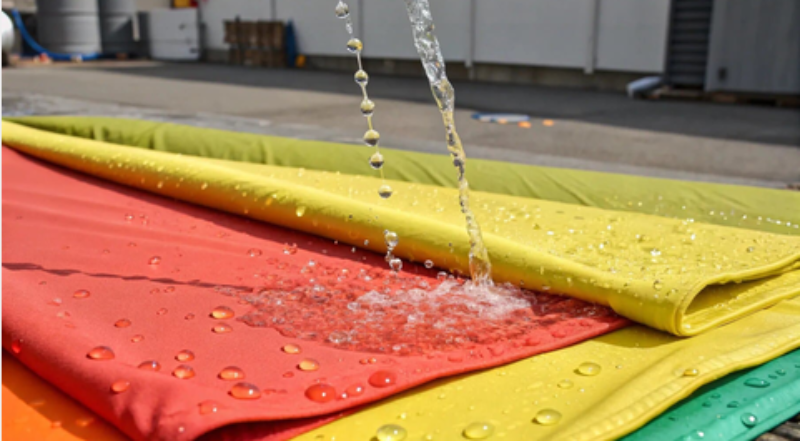
As PFAS regulations tighten, achieving durable water beading without fluorinated chemistry becomes critical for textile mills.
How PFAS Regulations Are Reshaping the Textile Water Repellent Industry
PFAS regulations are reshaping the textile water repellent industry by stripping the legal basis away from fluorinated DWR products and forcing mills to qualify non-fluorine alternatives as the default finish for water-repellent textiles.
ECHA submitted a universal PFAS restriction to the European Commission in early 2023. The proposal covers more than 10,000 per- and polyfluoroalkyl substances and gives textiles a 12-year transition period. In the United States, Maine prohibits the sale of textiles with intentionally added PFAS from 1 January 2030, and Minnesota's Amara's Law bans intentionally added PFAS in most product categories, textiles included, by 2032.
- EU REACH: one broad restriction covering the whole PFAS class, with a 12-year transition proposed for textile uses.
- Maine, USA: sale of PFAS-containing textiles banned from 2030 where alternatives are available.
- Minnesota, USA: intentionally added PFAS prohibited in most products from 2032, with earlier deadlines for priority categories.
The practical consequence is that "PFAS-free" is moving from a marketing badge to a contractual requirement on order sheets. Finishing mills now need documented proof of formulation, add-on level, and curing parameters - evidence a fluorinated DWR can no longer provide in any major export market.
Definition
A fluorine-free water repellent is a textile finish formulated without per- or polyfluoroalkyl substances. It lowers fabric surface energy using hydrocarbon, silicone, dendrimer, or polyurethane chemistry to give liquid water roll-off without oil repellency.
10,000+PFAS substances covered by the EU REACH proposal
12 yearsProposed REACH transition for textiles
2030Maine textile sales ban takes effect
2032Minnesota general PFAS product ban
PFAS Regulations Push DWR Chemistry from C6 Fluoropolymers to Fluorine-Free Alternatives
No reformulation can make a C6 fluorotelomer-based DWR compliant, because the restriction targets the entire substance class rather than a specific chain length. Side-chain fluorinated polymers degrade into persistent substances such as 6:2 fluorotelomer alcohol, which falls under the EU proposal's broad definition of any chemical with at least one fully fluorinated carbon atom.
That is why the market has only one viable direction: switch the polymer family. The main non-fluorine families a mill will encounter are paraffin wax emulsions, dendrimeric hydrocarbons, modified polyurethane dispersions, and silicone-modified products. All of them repel liquid water, but none can replicate the oil repellency of a fluoropolymer.
Mills should expect four measurable differences between a C6 finish and a fluorine-free finish:
- Initial spray rating: premium fluorine-free grades reach 90-100 on the ISO 4920 scale, while C6 products reach 100 with less add-on.
- Wash durability: the durability of F-free products depends heavily on cross-linking, so curing discipline matters as much as the chemistry.
- Oil repellency: drops from AATCC 118 grade 5-6 on C6 chemistry to grade 0-1 on most fluorine-free products.
- Hand feel: silicone-modified F-free finishes can be softer than a traditional fluoropolymer, while paraffin-based variants feel waxy and heavier.
Representative benchmark: C6 fluorotelomer DWR versus fluorine-free DWR
C6 fluorotelomerFluorine-free
Initial spray rating (ISO 4920, 100 scale)
Spray rating after 20 home launderings
Oil repellency (AATCC 118, grade out of 8)
Oil repellency is the property that almost always disappears when a mill moves off fluorinated chemistry. If the final order does not demand oil repellency - and most apparel does not - the loss is acceptable. If it does, no fluorine-free grade can substitute.
How PFAS Regulations Change the Way Mills Approve Water Repellent Finishes
The fastest way to fail an F-free transition is to treat the new product as a drop-in replacement for the old C6 product. Temperature curves, add-on levels, curing speeds, and compatibility with softeners all have to be revalidated on the production machine.
Practical re-approval steps
- Confirm the curing window. Dendrimer and polyurethane grades typically cross-link between 150 and 170 °C; polyester and cotton-polyester blends handle that temperature, but nylon and elastane blends need a low-cure grade.
- Reset the padding concentration and wet pick-up. F-free chemistry often requires a slightly higher add-on to build the same water-beading effect.
- Check compatibility with the softener, anti-wicking agent, and curing catalyst in the same pad bath. Silicone-modified grades can behave differently when mixed with cationic softeners.
- Run at least 20 home launderings on the actual fabric construction before approving the new product for production.
For the full evaluation workflow, the guide on how to select water repellent agents for your dye factory walks through each step from fiber type to final lab report.
For mills moving toward compliance, Hubei Zezhuang Technology Industrial Development Co., Ltd., with production bases in Hangzhou and Jingzhou, formulates a dedicated range of fluorine-free DWRs.
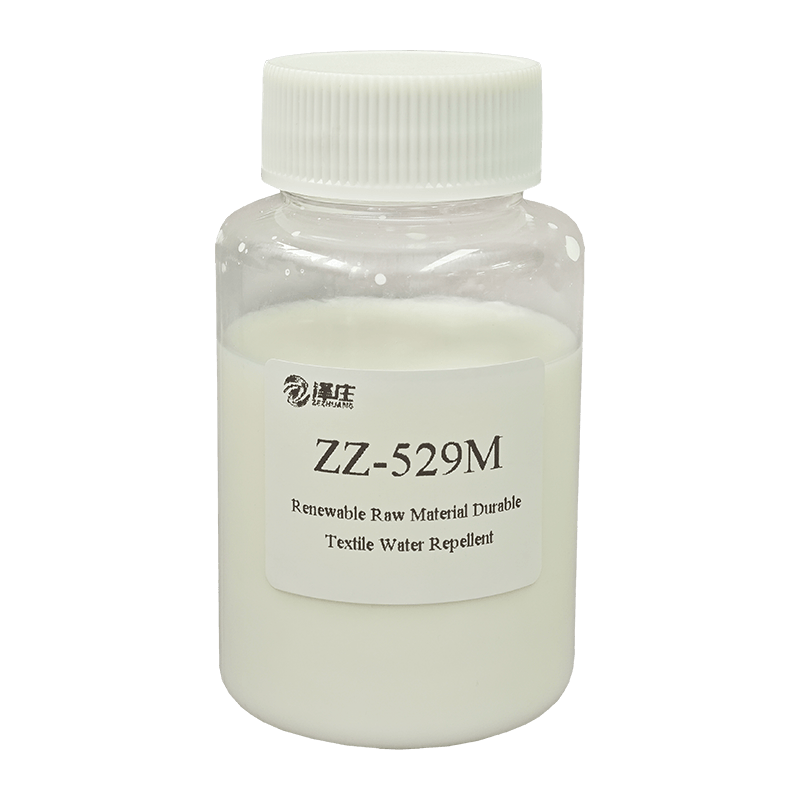 ZZ-529M Renewable-Content Durable Water Repellent for TextilesThis fluorine-free, renewable-raw-material finish offers wash-resistant waterproofing for fabrics and nonwovens. Its weak cationic, alkyl urea ester formulation suits outdoor and brand-driven collections requiring durable performance.View Product →
For orders that demand renewable content and long-wash durability, the ZZ529M renewable-raw-material grade is designed for durable performance in outdoor and brand-driven collections.
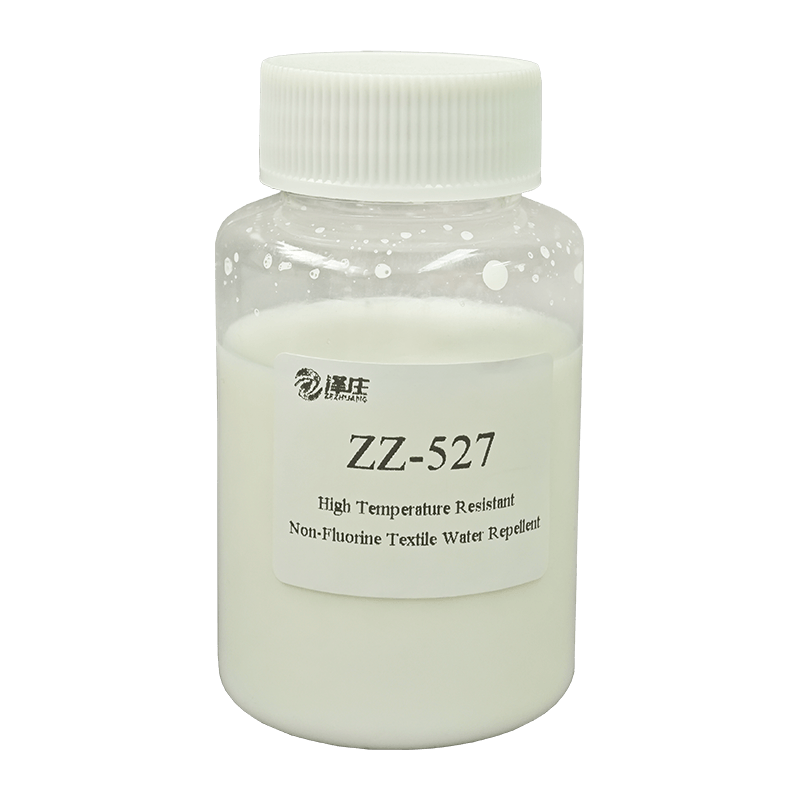 ZZ-527 High-Temperature-Resistant Non-Fluorine Water RepellentDesigned for high curing temperatures, this fluorine-free, APEO-free acrylate polyurethane emulsion keeps water repellency without polymer degradation. It provides soft hand feel and water bead bouncing on polyester.View Product →
Where the production line runs high curing temperatures, the ZZ527 high-temperature-resistant non-fluorine finish keeps water repellency without polymer degradation.
 ZZ-523H Anti-Siphoning Fluorine-Free Water Repellent for Shoe MaterialsTargeting wicking along seams and laces, this fluorine-free acrylic polymer finish blocks liquid migration in cotton and polyester-cotton blends. It is cold-water miscible and suited for shoe factory applications.View Product →
Shoe factories face a different failure mode: liquid migrating upward along seams and laces. The ZZ523H shoe-material anti-siphoning fluorine-free water repellent is formulated to block that specific wicking path.
The compliance file matters as much as the chemistry: curing temperature, add-on, and wash-test results for every F-free grade become the audit trail that importers will request at the next order review.
Matching Fluorine-Free Water Repellents to Fabric and End-Use Requirements
Fiber composition, curing temperature, softness target, and wash-durability requirement decide which fluorine-free water repellent belongs on the work order, and no single grade covers all fabrics.
Hubei Zezhuang Technology Industrial Development Co., Ltd. organizes its fluorine-free line around processing conditions and end-uses: silicone-modified grades for hand feel, a low-temperature grade for heat-sensitive blends, a high-temperature grade for technical woven, and a renewable grade for eco-rated programs.
Portfolio comparison by application scenario
| Product | Best positioned for | Processing feature | Performance target |
| ZZ510 | Soft-feel knits, sportswear | Silicone co-emulsion | Soft handle with water beading |
| ZZ512 | General wovens and knits | Ready-to-use soft finish | Balanced water repellency |
| ZZ526 | Nylon, spandex blends | Low-temperature cure | Stain resistance and energy saving |
| ZZ527 | Automotive, technical fabrics | High-temperature stable | Durability under heat exposure |
| ZZ528 | Cotton-polyester workwear | Optimized for blends | Even coverage on hydrophilic cotton |
| ZZ529M | Eco-certified outdoor lines | Renewable raw materials | Durability across 20+ washes |
| ZZ523H | Shoe upper, lining, laces | Anti-siphoning formulation | Blocks wicking along seams |
Selection rule: if the curing range is above 150 °C, use dendrimer or polyurethane durable grades; if the fabric is heat-sensitive, use a low-cure silicone-modified grade. The fabric's temperature tolerance, not the marketing label, decides the product.
When the technical team rewrites the internal specification, it helps to start from the real difference between water repellent, water resistant, and waterproof. Most fluorine-free products deliver repellency and resistance, not waterproofness, and the labeling language must match that reality.
Frequently Asked Questions about PFAS Regulations and Water Repellents
What does PFAS-free actually mean for a water repellent?
It means the finish is formulated without any per- or polyfluoroalkyl substance, normally verified by total fluorine below 25 ppm in the finished fabric using an ion chromatography method such as EN 14582. In practice, water rolls off the surface while oil and grease do not.
Are fluorine-free water repellents as durable as C6 fluoropolymer finishes?
In spray-rating terms, premium fluorine-free grades hold 80-90 after 20 home launderings when cured correctly, which is close to C6 levels. The visible gap appears on oil repellency and on heavy industrial laundering; for most apparel programs, the difference is acceptable.
How do I know if my current DWR contains PFAS?
Request a declaration from the chemical supplier, check the safety data sheet for fluorinated side-chain polymers, and run a total fluorine screening on the finished fabric. If total fluorine exceeds 25 ppm, current EU proposals will treat the article as PFAS-containing.
Do PFAS regulations apply to textiles imported from outside the EU or the US?
Yes. The EU REACH restriction and the US state bans are sales prohibitions, so they apply to any textile placed on the market in that jurisdiction regardless of where it was dyed and finished. Importers will demand fluorine-free declarations and laboratory test reports from their suppliers.
Regulation has become the main driver of DWR formulation choice. The mills that re-qualify fluorine-free finishes early, document curing parameters, and translate performance data into clear customer specifications will face the shortest compliance gap when the bans land.
Zezhuang's in-house R&D and testing center supports this transition by providing comprehensive compliance dossiers, total fluorine screening, and wash-durability validation before bulk production. If your team is evaluating a fluorine-free DWR for upcoming export orders, contact us here to request a sample or a technical consultation.

Zezhuang's testing center provides total fluorine screening and wash-durability validation.